The Two Babylons
Chapter VII
The Two Developments Historically and Prophetically Considered
Section
I
The Great Red Dragon
Hitherto we have considered the history of the Two Babylons chiefly in detail. Now we are to view them as organised systems. The idolatrous system of the ancient Babylon assumed different phases in different periods of its history. In the prophetic description of the modern Babylon, there is evidently also a development of different powers at different times. Do these two developments bear any typical relation to each other? Yes, they do. When we bring the religious history of the ancient Babylonian Paganism to bear on the prophetic symbols that shadow forth the organised working of idolatry in Rome, it will be found that it casts as much light on this view of the subject as on that which has hitherto engaged our attention. The powers of iniquity at work in the modern Babylon are specifically described in chapters 12 and 13 of the Revelation; and they are as follows:--I. The Great Red Dragon; II. The Beast that comes up out of the sea; III. The Beast that ascendeth out of the earth; and IV. The Image of the Beast. In all these respects it will be found, on inquiry, that, in regard to succession and order of development, the Paganism of the Old Testament Babylon was the exact type of the Paganism of the new.
Section
I
The Great Red Dragon
This formidable enemy of the truth is particularly described in Revelation 12:3--"And there appeared another wonder in heaven, a great red dragon." It is admitted on all hands that this is the first grand enemy that in Gospel times assaulted the Christian Church. If the terms in which it is described, and the deeds attributed to it, are considered, it will be found that there is a great analogy between it and the first enemy of all, that appeared against the ancient Church of God soon after the Flood. The term dragon, according to the associations currently connected with it, is somewhat apt to mislead the reader, by recalling to his mind the fabulous dragons of the Dark Ages, equipped with wings. At the time this Divine description was given, the term dragon had no such meaning among either profane or sacred writers. "The dragon of the Greeks," says Pausanias, "was only a large snake"; and the context shows that this is the very case here; for what in the third verse is called a "dragon," in the fourteenth is simply described as a "serpent." Then the word rendered "Red" properly means "Fiery"; so that the "Red Dragon" signifies the "Fiery Serpent" or "Serpent of Fire." Exactly so does it appear to have been in the first form of idolatry, that, under the patronage of Nimrod, appeared in the ancient world. The "Serpent of Fire" in the plains of Shinar seems to have been the grand object of worship. There is the strongest evidence that apostacy among the sons of Noah began in fire-worship, and that in connection with the symbol of the serpent.
We have seen already, on different occasions, that fire was worshipped as the enlightener and the purifier. Now, it was thus at the very beginning; for Nimrod is singled out by the voice of antiquity as commencing this fire-worship. The identity of Nimrod and Ninus has already been proved; and under the name of Ninus, also, he is represented as originating the same practice. In a fragment of Apollodorus it is said that "Ninus taught the Assyrians to worship fire." The sun, as the great source of light and heat, was worshipped under the name of Baal. Now, the fact that the sun, under that name, was worshipped in the earliest ages of the world, shows the audacious character of these first beginnings of apostacy. Men have spoken as if the worship of the sun and of the heavenly bodies was a very excusable thing, into which the human race might very readily and very innocently fall. But how stands the fact? According to the primitive language of mankind, the sun was called "Shemesh"--that is, "the Servant"--that name, no doubt, being divinely given, to keep the world in mind of the great truth that, however glorious was the orb of day, it was, after all, the appointed Minister of the bounty of the great unseen Creator to His creatures upon earth. Men knew this, and yet with the full knowledge of it, they put the servant in the place of the Master; and called the sun Baal--that is, the Lord--and worshipped him accordingly. What a meaning, then, in the saying of Paul, that, "when they knew God, they glorified Him not as God"; but "changed the truth of God into a lie, and worshipped and served the creature more than the Creator, who is God over all, blessed for ever." The beginning, then, of sun-worship, and of the worship of the host of heaven, was a sin against the light--a presumptuous, heaven-daring sin. As the sun in the heavens was the great object of worship, so fire was worshipped as its earthly representative. To this primeval fire-worship Vitruvius alludes when he says that "men were first formed into states and communities by meeting around fires." And this is exactly in conformity with what we have already seen in regard to Phoroneus, whom we have identified with Nimrod, that while he was said to be the "inventor of fire," he was also regarded as the first that "gathered mankind into communities."
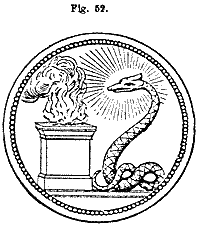
Along with the sun, as the great fire-god, and, in due time, identified with him, was the serpent worshipped. "In the mythology of the primitive world," says Owen, "the serpent is universally the symbol of the sun." In Egypt, one of the commonest symbols of the sun, or sun-god, is a disc with a serpent around it. The original reason of that identification seems just to have been that, as the sun was the great enlightener of the physical world, so the serpent was held to have been the great enlightener of the spiritual, by giving mankind the "knowledge of good and evil." This, of course, implies tremendous depravity on the part of the ring-leaders in such a system, considering the period when it began; but such appears to have been the real meaning of the identification. At all events, we have evidence, both Scriptural and profane, for the fact, that the worship of the serpent began side by side with the worship of fire and the sun. The inspired statement of Paul seems decisive on the subject. It was, he says, "when men knew God, but glorified Him not as God," that they changed the glory of God, not only into an image made like to corruptible man, but into the likeness of "creeping things"--that is, of serpents (Rom 1:23). With this profane history exactly coincides. Of profane writers, Sanchuniathon, the Phoenician, who is believed to have lived about the time of Joshua, says--"Thoth first attributed something of the divine nature to the serpent and the serpent tribe, in which he was followed by the Phoenicians and Egyptians. For this animal was esteemed by him to be the most spiritual of all the reptiles, and of a FIERY nature, inasmuch as it exhibits an incredible celerity, moving by its spirit, without either hands or feet...Moreover, it is long-lived, and has the quality of RENEWING ITS YOUTH...as Thoth has laid down in the sacred books; upon which accounts this animal is introduced in the sacred rites and Mysteries."
Now, Thoth, it will be remembered, was the counsellor of Thamus, that is, Nimrod. From this statement, then, we are led to the conclusion that serpent-worship was a part of the primeval apostacy of Nimrod. The "FIERY NATURE" of the serpent, alluded to in the above extract, is continually celebrated by the heathen poets. Thus Virgil, "availing himself," as the author of Pompeii remarks, "of the divine nature attributed to serpents," describes the sacred serpent that came from the tomb of Anchises, when his son Aeneas had been sacrificing before it, in such terms as illustrate at once the language of the Phoenician, and the "Fiery Serpent" of the passage before us:--
"Scarce
had he finished, when, with speckled pride,
A serpent from the tomb began to glide;
His hugy bulk on seven high volumes rolled,
Blue was his breadth of back, but streaked with scaly gold.
Thus, riding on his curls, he seemed to pass
A rolling fire along, and singe the grass."
It is not wonderful, then, the fire-worship and serpent-worship should be conjoined. The serpent, also, as "renewing its youth" every year, was plausibly represented to those who wished an excuse for idolatry as a meet emblem of the sun, the great regenerator, who every year regenerates and renews the face of nature, and who, when deified, was worshipped as the grand Regenerator of the souls of men.
In the chapter under consideration, the "great fiery serpent" is represented with all the emblems of royalty. All its heads are encircled with "crowns or diadems"; and so in Egypt, the serpent of fire, or serpent of the sun, in Greek was called the Basilisk, that is, the "royal serpent," to identify it with Moloch, which name, while it recalls the ideas both of fire and blood, properly signifies "the King." The Basilisk was always, among the Egyptians, and among many nations besides, regarded as "the very type of majesty and dominion." As such, its image was worn affixed to the head-dress of the Egyptian monarchs; and it was not lawful for any one else to wear it. The sun identified with this serpent was called "P'ouro," which signifies at one "the Fire" and "the King," and from this very name the epithet "Purros," the "Fiery," is given to the "Great seven-crowned serpent" of our text. *
* The word Purros in the text does not exclude the idea of "Red," for the sun-god was painted red to identify him with Moloch, at once the god of fire and god of blood.--(WILKINSON). The primary leading idea, however, is that of Fire.
Thus was the Sun, the Great Fire-god, identified with the Serpent. But he had also a human representative, and that was Tammuz, for whom the daughters of Israel lamented, in other words Nimrod. We have already seen the identity of Nimrod and Zoroaster. Now, Zoroaster was not only the head of the Chaldean Mysteries, but, as all admit, the head of the fire-worshippers.(see note below) The title given to Nimrod, as the first of the Babylonian kings, by Berosus, indicates the same thing. That title is Alorus, that is, "the god of fire." As Nimrod, "the god of fire," was Molk-Gheber, or, "the Mighty king," inasmuch as he was the first who was called Moloch, or King, and the first who began to be "mighty" (Gheber) on the earth, we see at once how it was that the "passing through the fire to Moloch" originated, and how the god of fire among the Romans came to be called "Mulkiber." *
* Commonly spelled Mulciber (OVID, Art. Am.); but the Roman c was hard. From the epithet "Gheber," the Parsees, or fire-worshippers of India, are still called "Guebres."
It was only after his death, however, that he appears to have been deified. Then, retrospectively, he was worshipped as the child of the Sun, or the Sun incarnate. In his own life-time, however, he set up no higher pretensions than that of being Bol-Khan, or Priest of Baal, from which the other name of the Roman fire-god Vulcan is evidently derived. Everything in the history of Vulcan exactly agrees with that of Nimrod. Vulcan was "the most ugly and deformed" of all the gods. Nimrod, over all the world, is represented with the features and complexion of a negro. Though Vulcan was so ugly, that when he sought a wife, "all the beautiful goddesses rejected him with horror"; yet "Destiny, the irrevocable, interposed, and pronounced the decree, by which [Venus] the most beautiful of the goddesses, was united to the most unsightly of the gods." So, in spite of the black and Cushite features of Nimrod, he had for his queen Semiramis, the most beautiful of women. The wife of Vulcan was noted for her infidelities and licentiousness; the wife of Nimrod was the very same. * Vulcan was the head and chief of the Cyclops, that is, "the kings of flame." **
* Nimrod, as universal king, was Khuk-hold, "King of the world." As such, the emblem of his power was the bull's horns. Hence the origin of the Cuckhold's horns.
** Kuclops, from Khuk, "king," and Lohb, "flame." The image of the great god was represented with three eyes--one in the forehead; hence the story of the Cyclops with the one eye in the forehead.
Nimrod was the head of the fire-worshippers. Vulcan was the forger of the thunderbolts by which such havoc was made among the enemies of the gods. Ninus, or Nimrod, in his wars with the king of Bactria, seems to have carried on the conflict in a similar way. From Arnobius we learn, that when the Assyrians under Ninus made war against the Bactrians, the warfare was waged not only by the sword and bodily strength, but by magic and by means derived from the secret instructions of the Chaldeans. When it is known that the historical Cyclops are, by the historian Castor, traced up to the very time of Saturn or Belus, the first king of Babylon, and when we learn that Jupiter (who was worshipped in the very same character as Ninus, "the child"), when fighting against the Titans, "received from the Cyclops aid" by means of "dazzling lightnings and thunders," we may have some pretty clear idea of the magic arts derived from the Chaldean Mysteries, which Ninus employed against the Bactrian king. There is evidence that, down to a late period, the priests of the Chaldean Mysteries knew the composition of the formidable Greek fire, which burned under water, and the secret of which has been lost; and there can be little doubt that Nimrod, in erecting his power, availed himself of such or similar scientific secrets, which he and his associates alone possessed.
In these, and other respects yet to be noticed, there is an exact coincidence between Vulcan, the god of fire of the Romans, and Nimrod, the fire-god of Babylon. In the case of the classic Vulcan, it is only in his character of the fire-god as a physical agent that he is popularly represented. But it was in his spiritual aspects, in cleansing and regenerating the souls of men, that the fire-worship told most effectually on the world. The power, the popularity, and skill of Nimrod, as well as the seductive nature of the system itself, enabled him to spread the delusive doctrine far and wide, as he was represented under the well-known name of Phaethon, (see note below) as on the point of "setting the whole world on fire," or (without the poetical metaphor) of involving all mankind in the guilt of fire-worship. The extraordinary prevalence of the worship of the fire-god in the early ages of the world, is proved by legends found over all the earth, and by facts in almost every clime. Thus, in Mexico, the natives relate, that in primeval times, just after the first age, the world was burnt up with fire. As their history, like the Egyptian, was written in Hieroglyphics, it is plain that this must be symbolically understood. In India, they have a legend to the very same effect, though somewhat varied in its form. The Brahmins say that, in a very remote period of the past, one of the gods shone with such insufferable splendour, "inflicting distress on the universe by his effulgent beams, brighter than a thousand worlds," * that, unless another more potent god had interposed and cut off his head, the result would have been most disastrous.
* SKANDA PURAN, and PADMA PURAN, apud KENNEDY'S Hindoo Mythology, p. 275. In the myth, this divinity is represented as the fifth head of Brahma; but as this head is represented as having gained the knowledge that made him so insufferably proud by perusing the Vedas produced by the other four heads of Brahma, that shows that he must have been regarded as having a distinct individuality.
In the Druidic Triads of the old British Bards, there is distinct reference to the same event. They say that in primeval times a "tempest of fire arose, which split the earth asunder to the great deep," from which none escaped but "the select company shut up together in the enclosure with the strong door," with the great "patriarch distinguished for his integrity," that is evidently with Shem, the leader of the faithful--who preserved their "integrity" when so many made shipwreck of faith and a good conscience. These stories all point to one and the same period, and they show how powerful had been this form of apostacy. The Papal purgatory and the fires of St. John's Eve, which we have already considered, and many other fables or practices still extant, are just so many relics of the same ancient superstition.
It will be observed, however, that the Great Red Dragon, or Great Fiery Serpent, is represented as standing before the Woman with the crown of twelve stars, that is, the true Church of God, "To devour her child as soon as it should be born." Now, this is in exact accordance with the character of the Great Head of the system of fire-worship. Nimrod, as the representative of the devouring fire to which human victims, and especially children, were offered in sacrifice, was regarded as the great child-devourer. Though, at his first deification, he was set up himself as Ninus, or the child, yet, as the first of mankind that was deified, he was, of course, the actual father of all the Babylonian gods; and, therefore, in that character he was afterwards universally regarded. *
* Phaethon, though the child of the sun, is also called the Father of the gods. (LACTANTIUS, De Falsa Religione) In Egypt, too, Vulcan was the Father of the gods. (AMMIANUS MARCELLINUS)
As the Father of the gods, he was, as we have seen, called Kronos; and every one knows that the classical story of Kronos was just this, that, "he devoured his sons as soon as they were born." Such is the analogy between type and antitype. This legend has a further and deeper meaning; but, as applied to Nimrod, or "The Horned One," it just refers to the fact, that, as the representative of Moloch or Baal, infants were the most acceptable offerings at his altar. We have ample and melancholy evidence on this subject from the records of antiquity. "The Phenicians," says Eusebius, "every year sacrificed their beloved and only-begotten children to Kronos or Saturn, and the Rhodians also often did the same." Diodorus Siculus states that the Carthaginians, on one occasion, when besieged by the Sicilians, and sore pressed, in order to rectify, as they supposed, their error in having somewhat departed from the ancient custom of Carthage, in this respect, hastily "chose out two hundred of the noblest of their children, and publicly sacrificed them" to this god. There is reason to believe that the same practice obtained in our own land in the times of the Druids. We know that they offered human sacrifices to their bloody gods. We have evidence that they made "their children pass through the fire to Moloch," and that makes it highly probable that they also offered them in sacrifice; for, from Jeremiah 32:35, compared with Jeremiah 19:5, we find that these two things were parts of one and the same system. The god whom the Druids worshipped was Baal, as the blazing Baal-fires show, and the last-cited passage proves that children were offered in sacrifice to Baal. When "the fruit of the body" was thus offered, it was "for the sin of the soul." And it was a principle of the Mosaic law, a principle no doubt derived from the patriarchal faith, that the priest must partake of whatever was offered as a sin-offering (Num 18:9,10). Hence, the priests of Nimrod or Baal were necessarily required to eat of the human sacrifices; and thus it has come to pass that "Cahna-Bal," * the "Priest of Baal," is the established word in our own tongue for a devourer of human flesh. **
* The word Cahna is the emphatic form of Cahn. Cahn is "a priest," Cahna is "the priest."
** From the historian Castor (in Armenian translation of EUSEBIUS) we learn that it was under Bel, or Belus, that is Baal, that the Cyclops lived; and the Scholiast on Aeschylus states that these Cyclops were the brethren of Kronos, who was also Bel or Bal, as we have elsewhere seen. The eye in their forehead shows that originally this name was a name of the great god; for that eye in India and Greece is found the characteristic of the supreme divinity. The Cyclops, then, had been representatives of that God--in other words, priests, and priests of Bel or Bal. Now, we find that the Cyclops were well-known as cannibals, Referre ritus Cyclopum, "to bring back the rites of the Cyclops," meaning to revive the practice of eating human flesh. (OVID, Metam.)
Now, the ancient traditions relate that the apostates who joined in the rebellion of Nimrod made war upon the faithful among the sons of Noah. Power and numbers were on the side of the fire-worshippers. But on the side of Shem and the faithful was the mighty power of God's Spirit. Therefore many were convinced of their sin, arrested in their evil career; and victory, as we have already seen, declared for the saints. The power of Nimrod came to an end, * and with that, for a time, the worship of the sun, and the fiery serpent associated with it.
* The wars of the giants against heaven, referred to in ancient heathen writers, had primary reference to this war against the saints; for men cannot make war upon God except by attacking the people of God. The ancient writer Eupolemus, as quoted by Eusebius (Praeparatio Evang.), states, that the builders of the tower of Babel were these giants; which statement amounts nearly to the same thing as the conclusion to which we have already come, for we have seen that the "mighty ones" of Nimrod were "the giants" of antiquity. Epiphanius records that Nimrod was a ringleader among these giants, and that "conspiracy, sedition, and tyranny were carried on under him." From the very necessity of the case, the faithful must have suffered most, as being most opposed to his ambitious and sacrilegious schemes. That Nimrod's reign terminated in some very signal catastrophe, we have seen abundant reason already to conclude. The following statement of Syncellus confirms the conclusions to which we have already come as to the nature of that catastrophe; referring to the arresting of the tower-building scheme, Syncellus (Chronographia) proceeds thus: "But Nimrod would still obstinately stay (when most of the other tower-builders were dispersed), and reside upon the spot; nor could he be withdrawn from the tower, still having the command over no contemptible body of men. Upon this, we are informed, that the tower, being beat upon by violent winds, gave way, and by the just judgment of God, crushed him to pieces." Though this could not be literally true, for the tower stood for many ages, yet there is a considerable amount of tradition to the effect that the tower in which Nimrod gloried was overthrown by wind, which gives reason to suspect that this story, when properly understood, had a real meaning in it. Take it figuratively, and remembering that the same word which signifies the wind signifies also the Spirit of God, it becomes highly probable that the meaning is, that his lofty and ambitious scheme, by which, in Scriptural language, he was seeking to "mount up to heaven," and "set his nest among the stars," was overthrown for a time by the Spirit of God, as we have already concluded, and that, in that overthrow he himself perished.
The case was exactly as stated here in regard to the antitype (Rev 12:9): "The great dragon," or fiery serpent, was "cast out of heaven to the earth, and his angels were cast out with him"; that is, the Head of the fire-worship, and all his associates and underlings, were cast down from the power and glory to which they had been raised. Then was the time when the whole gods of the classic Pantheon of Greece were fain to flee and hide themselves from the wrath of their adversaries. Then it was, that, in India, Indra, the king of the gods, Surya, the god of the sun, Agni, the god of fire, and all the rabble rout of the Hindu Olympus, were driven from heaven, wandered over the earth, or hid themselves, in forests, disconsolate, and ready to "perish of hunger." Then it was that Phaethon, while driving the chariot of the sun, when on the point of setting the world on fire, was smitten by the Supreme God, and cast headlong to the earth, while his sisters, the daughters of the sun, inconsolably lamented him, as, "the women wept for Tammuz." Then it was, as the reader must be prepared to see, that Vulcan, or Molk-Gheber, the classic "god of fire," was so ignominiously hurled down from heaven, as he himself relates in Homer, speaking of the wrath of the King of Heaven, which in this instance must mean God Most High:--
"I
felt his matchless might,
Hurled headlong downwards from the ethereal height;
Tossed all the day in rapid circles round,
Nor, till the sun descended, touched the ground.
Breathless I fell, in giddy motion lost.
The Sinthians raised me on the Lemnian coast."
The lines, in which Milton refers to this same downfall, though he gives it another application, still more beautifully describe the greatness of the overthrow:--
"In
Ausonian land
Men called him Mulciber; and how he fell
From heaven, they fabled. Thrown by angry Jove
Sheer o'er the crystal battlements; from morn
To noon he fell, from noon to dewy eve,
A summer's day; and, with the setting sun,
Dropped from the zenith, like a falling star.
On Lemnos, the Aegean isle."
Paradise Lost
These words very strikingly show the tremendous fall of Molk-Gheber, or Nimrod, "the Mighty King," when "suddenly he was cast down from the height of his power, and was deprived at once of his kingdom and his life." *
* The Greek poets speak of two downfalls of Vulcan. In the one case he was cast down by Jupiter, in the other by Juno. When Jupiter cast him down, it was for rebellion; when Juno did so, one of the reasons specially singled out for doing so was his "malformation," that is, his ugliness. (HOMER'S Hymn to Apollo) How exactly does this agree with the story of Nimrod: First he was personally cast down, when, by Divine authority, he was slain. Then he was cast down, in effigy, by Juno, when his image was degraded from the arms of the Queen of Heaven, to make way for the fairer child.
Now, to this overthrow there is very manifest allusion in the prophetic apostrophe of Isaiah to the king of Babylon, exulting over his approaching downfall: "How art thou fallen from heaven, O Lucifer, son of the morning"! The Babylonian king pretended to be a representative of Nimrod or Phaethon; and the prophet, in these words, informs him, that, as certainly as the god in whom he gloried had been cast down from his high estate, so certainly should he. In the classic story, Phaethon is said to have been consumed with lightning (and, as we shall see by-and-by, Aesculapius also died the same death); but the lightning is a mere metaphor for the wrath of God, under which his life and his kingdom had come to an end. When the history is examined, and the figure stripped off, it turns out, as we have already seen, that he was judicially slain with the sword. *
* Though Orpheus was commonly represented as having been torn in pieces, he too was fabled to have been killed by lightning. (PAUSANIAS, Boeotica) When Zoroaster died, he also is said in the myth to have perished by lightning (SUIDAS); and therefore, in accordance with that myth, he is represented as charging his countrymen to preserve not his body, but his "ashes." The death by lightning, however, is evidently a mere figure.
Such is the language of the prophecy, and so exactly does it correspond with the character, and deeds, and fate of the ancient type. How does it suit the antitype? Could the power of Pagan Imperial Rome--that power that first persecuted the Church of Christ, that stood by its soldiers around the tomb of the Son of God Himself, to devour Him, if it had been possible, when He should be brought forth, as the first-begotten from the dead, * to rule all nations--be represented by a "Fiery Serpent"?
* The birth of the Man-child, as given above, is different from that usually given: but let the reader consider if the view which I have taken does not meet all the requirements of the case. I think there will be but few who will assent to the opinion of Mr. Elliot, which in substance amounts to this, that the Man-child was Constantine the Great, and that when Christianity, in his person sat down on the throne of Imperial Rome, that was the fulfilment of the saying, that the child brought forth by the woman, amid such pangs of travail, was "caught up to God and His throne." When Constantine came to the empire, the Church indeed, as foretold in Daniel 11:34, "was holpen with a little help"; but that was all. The Christianity of Constantine was but of a very doubtful kind, the Pagans seeing nothing in it to hinder but that when he died, he should be enrolled among their gods. (EUTROPIUS) But even though it had been better, the description of the woman's child is far too high for Constantine, or any Christian emperor that succeeded him on the imperial throne. "The Man-child, born to rule all nations with a rod of iron," is unequivocally Christ (see Psalms 2:9; Rev 19:15). True believers, as one with Him in a subordinate sense, share in that honour (Rev 2:27); but to Christ alone, properly, does that prerogative belong; and I think it must be evident that it is His birth that is here referred to. But those who have contended for this view have done injustice to their cause by representing this passage as referring to His literal birth in Bethlehem. When Christ was born in Bethlehem, no doubt Herod endeavoured to cut Him off, and Herod was a subject of the Roman Empire. But it was not from any respect to Caesar that he did so, but simply from fear of danger to his own dignity as King of Judea. So little did Caesar sympathise with the slaughter of the children of Bethlehem, that it is recorded that Augustus, on hearing of it, remarked that it was "better to be Herod's hog than to be his child." (MACROBIUS, Saturnalia) Then, even if it were admitted that Herod's bloody attempt to cut off the infant Saviour was symbolised by the Roman dragon, "standing ready to devour the child as soon as it should be born," where was there anything that could correspond to the statement that the child, to save it from that dragon, "was caught up to God and His Throne"? The flight of Joseph and Mary with the Child into Egypt could never answer to such language. Moreover, it is worthy of special note, that when the Lord Jesus was born in Bethlehem, He was born, in a very important sense only as "King of the Jews." "Where is He that is born King of the Jews?" was the inquiry of the wise men that came from the East to seek Him. All His life long, He appeared in no other character; and when He died, the inscription on His cross ran in these terms: "This is the King of the Jews." Now, this was no accidental thing. Paul tells us (Rom 15:8) that "Jesus Christ was a minister of the circumcision for the truth of God, to confirm the promises made unto the fathers." Our Lord Himself plainly declared the same thing. "I am not sent," said He to the Syrophoenician woman, "save to the lost sheep of the house of Israel"; and, in sending out His disciples during His personal ministry, this was the charge which He gave them: "Go not in the way of the Gentiles, and into any city of the Samaritans enter ye not." It was only when He was "begotten from the dead," and "declared to be the Son of God with power," by His victory over the grave, that He was revealed as "the Man-child, born to rule all nations." Then said He to His disciples, when He had risen, and was about to ascend on high: "All power is given unto Me in heaven and in earth: go ye therefore, and teach allnations." To this glorious "birth" from the tomb, and to the birth-pangs of His Church that preceded it, our Lord Himself made distinct allusion on the night before He was betrayed (John 16:20-22). "Verily, verily, I say unto you, That ye shall weep and lament, but the world shall rejoice; and ye shall be sorrowful, but your sorrow shall be turned into joy. A woman when she is in travail hath sorrow, because her hour is come; but as soon as she is delivered of the child, she remembereth no more the anguish, for joy that a MAN is born into the world. And ye now therefore have sorrow; but I will see you again, and your heart shall rejoice." Here the grief of the apostles, and, of course, all the true Church that sympathised with them during the hour and power of darkness, is compared to the pangs of a travailing woman; and their joy, when the Saviour should see them again after His resurrection, to the joy of a mother when safely delivered of a Man-child. Can there be a doubt, then, what the symbol before us means, when the woman is represented as travailing in pain to be delivered of a "Man-child, that was to rule all nations," and when it is said that that "Man-child was caught up to God and His Throne"?
Nothing could more lucidly show it forth. Among the lords many, and the gods many, worshipped in the imperial city, the two grand objects of worship were the "Eternal Fire," kept perpetually burning in the temple of Vesta, and the sacred Epidaurian Serpent. In Pagan Rome, this fire-worship and serpent-worship were sometimes separate, sometimes conjoined; but both occupied a pre-eminent place in Roman esteem. The fire of Vesta was regarded as one of the grand safeguards of the empire. It was pretended to have been brought from Troy by Aeneas, who had it confided to his care by the shade of Hector, and was kept with the most jealous care by the Vestal virgins, who, for their charge of it, were honoured with the highest honours. The temple where it was kept, says Augustine, "was the most sacred and most reverenced of all the temples of Rome." The fire that was so jealously guarded in that temple, and on which so much was believed to depend, was regarded in the very same light as by the old Babylonian fire-worshippers. It was looked upon as the purifier, and in April every year, at the Palilia, or feast of Pales, both men and cattle, for this purpose, were made to pass through the fire. The Epidaurian snake, that the Romans worshipped along with the fire, was looked on as the divine representation of Aesculapius, the child of the Sun. Aesculapius, whom that sacred snake represented, was evidently, just another name for the great Babylonian god. His fate was exactly the same as that of Phaethon. He was said to have been smitten with lightning for raising the dead. It is evident that this could never have been the case in a physical sense, nor could it easily have been believed to be so. But view it in a spiritual sense, and then the statement is just this, that he was believed to raise men who were dead in trespasses and sins to newness of life. Now, this was exactly what Phaethon was pretending to do, when he was smitten for setting the world on fire. In the Babylonian system there was a symbolical death, that all the initiated had to pass through, before they got the new life which was implied in regeneration, and that just to declare that they had passed from death unto life. As the passing through the fire was both a purgation from sin and the means of regeneration, so it was also for raising the dead that Phaethon was smitten. Then, as Aesculapius was the child of the Sun, so was Phaethon. *
* The birth of Aesculapius in the myth was just the same as that of Bacchus. His mother was consumed by lightning, and the infant was rescued from the lightning that consumed her, as Bacchus was snatched from the flames that burnt up his mother.--LEMPRIERE
To symbolise this relationship, the head of the image of Aesculapius was generally encircled with rays. The Pope thus encircles the heads of the pretended images of Christ; but the real source of these irradiations is patent to all acquainted either with the literature or the art of Rome. Thus speaks Virgil of Latinus:--
"And
now, in pomp, the peaceful kings appear,
Four steeds the chariot of Latinus bear,
Twelve golden beams around his temples play,
To mark his lineage from the god of day."
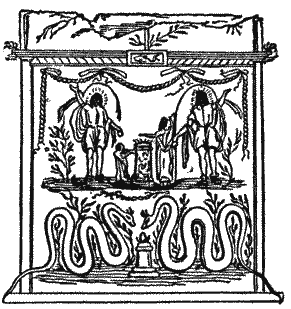
The "golden beams" around the head of Aesculapius were intended to mark the same, to point him out as the child of the Sun, or the Sun incarnate. The "golden beams" around the heads of pictures and images called by the name of Christ, were intended to show the Pagans that they might safely worship them, as the images of their well-known divinities, though called by a different name. Now Aesculapius, in a time of deadly pestilence, had been invited from Epidaurus to Rome. The god, under the form of a larger serpent, entered the ship that was sent to convey him to Rome, and having safely arrived in the Tiber, was solemnly inaugurated as the guardian god of the Romans. From that time forth, in private as well as in public, the worship of the Epidaurian snake, the serpent that represented the Sun-divinity incarnate, in other words, the "Serpent of Fire," became nearly universal. In almost every house the sacred serpent, which was a harmless sort, was to be found. "These serpents nestled about the domestic altars," says the author of Pompeii, "and came out, like dogs or cats, to be patted by the visitors, and beg for something to eat. Nay, at table, if we may build upon insulated passages, they crept about the cups of the guests, and, in hot weather, ladies would use them as live boas, and twist them round their necks for the sake of coolness...These sacred animals made war on the rats and mice, and thus kept down one species of vermin; but as they bore a charmed life, and no one laid violent hands on them, they multiplied so fast, that, like the monkeys of Benares, they became an intolerable nuisance. The frequent fires at Rome were the only things that kept them under." Some pictures represent Roman fire-worship and serpent-worship at once separate and conjoined. The reason of the double representation of the god I cannot here enter into, but it must be evident, from the words of Virgil already quoted, that the figures having their heads encircled with rays, represent the fire-god, or Sun-divinity; and what is worthy of special note is, that these fire-gods are black, * the colour thereby identifying them with the Ethiopian or black Phaethon; while, as the author of Pompeii himself admits, these same black fire-gods are represented by two huge serpents.
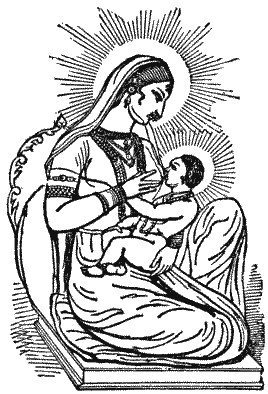
* "All the faces in his (MAZOIS') engraving are quite black." (Pompeii) In India, the infant Crishna (emphatically the black god), in the arms of the goddess Devaki, is represented with the woolly hair and marked features of the Negro or African race.
Now, if this worship of the sacred serpent of the Sun, the great fire-god, was so universal in Rome, what symbol could more graphically portray the idolatrous power of Pagan Imperial Rome than the "Great Fiery Serpent"? No doubt it was to set forth this very thing that the Imperial standard itself--the standard of the Pagan Emperor of Rome, as Pontifex Maximus, Head of the great system of fire-worship and serpent-worship--was a serpent elevated on a lofty pole, and so coloured, as to exhibit it as a recognised symbol of fire-worship. (see note below)
As Christianity spread in the Roman Empire, the powers of light and darkness came into collision (Rev 12:7,8): "Michael and his angels fought against the dragon; and the dragon fought and his angels, and prevailed not; neither was their place found any more in heaven. And the great dragon was cast out;...he was cast out into the earth, and his angels were cast out with him." The "great serpent of fire" was cast out, when, by the decree of Gratian, Paganism throughout the Roman empire was abolished--when the fires of Vesta were extinguished, and the revenues of the Vestal virgins were confiscated--when the Roman Emperor (who though for more than a century and a half a professor of Christianity, had been "Pontifex Maximus," the very head of the idolatry of Rome, and as such, on high occasions, appearing invested with all the idolatrous insignia of Paganism), through force of conscience abolished his own office. While Nimrod was personally and literally slain by the sword, it was through the sword of the Spirit that Shem overcame the system of fire-worship, and so bowed the hearts of men, as to cause it for a time to be utterly extinguished. In like manner did the Dragon of fire, in the Roman Empire, receive a deadly wound from a sword, and that the sword of the Spirit, which is the Word of God. There is thus far an exact analogy between the type and the antitype.
But not only is there this analogy. It turns out, when the records of history are searched to the bottom, that when the head of the Pagan idolatry of Rome was slain with the sword by the extinction of the office of Pontifex Maximus, the last Roman Pontifex Maximus was the ACTUAL, LEGITIMATE, SOLE REPRESENTATIVE OF NIMROD and his idolatrous system then existing. To make this clear, a brief glance at the Roman history is necessary. In common with all the earth, Rome at a very early prehistoric period, had drunk deep of Babylon's "golden cup." But above and beyond all other nations, it had had a connection with the idolatry of Babylon that put it in a position peculiar and alone. Long before the days of Romulus, a representative of the Babylonian Messiah, called by his name, had fixed his temple as a god, and his palace as a king, on one of those very heights which came to be included within the walls of that city which Remus and his brother were destined to found. On the Capitoline hill, so famed in after-days as the great high place of Roman worship, Saturnia, or the city of Saturn, the great Chaldean god, had in the days of dim and distant antiquity been erected. Some revolution had then taken place--the graven images of Babylon had been abolished--the erecting of any idol had been sternly prohibited, * and when the twin founders of the now world-renowned city reared its humble walls, the city and the palace of their Babylonian predecessor had long lain in ruins.
* PLUTARCH (in Hist. Numoe) states, that Numa forbade the making of images, and that for 170 years after the founding of Rome, no images were allowed in the Roman temples.
The ruined state of this sacred city, even in the remote age of Evander, is alluded to by Virgil. Referring to the time when Aeneas is said to have visited that ancient Italian king, thus he speaks:--
"Then
saw two heaps of ruins; once they stood
Two stately towns on either side the flood;
Saturnia and Janicula's remains;
And either place the founder's name retains."
The deadly wound, however, thus given to the Chaldean system, was destined to be healed. A colony of Etruscans, earnestly attached to the Chaldean idolatry, had migrated, some say from Asia Minor, others from Greece, and settled in the immediate neighbourhood of Rome. They were ultimately incorporated in the Roman state, but long before this political union took place they exercised the most powerful influence on the religion of the Romans. From the very first their skill in augury, soothsaying, and all science, real or pretended, that the augurs or soothsayers monopolised, made the Romans look up to them with respect. It is admitted on all hands that the Romans derived their knowledge of augury, which occupied so prominent a place in every public transaction in which they engaged, chiefly from the Tuscans, that is, the people of Etruria, and at first none but natives of that country were permitted to exercise the office of a Haruspex, which had respect to all the rites essentially involved in sacrifice. Wars and disputes arose between Rome and the Etruscans; but still the highest of the noble youths of Rome were sent to Etruria to be instructed in the sacred science which flourished there. The consequence was, that under the influence of men whose minds were moulded by those who clung to the ancient idol-worship, the Romans were brought back again to much of that idolatry which they had formerly repudiated and cast off. Though Numa, therefore, in setting up his religious system, so far deferred to the prevailing feeling of his day and forbade image-worship, yet in consequence of the alliance subsisting between Rome and Etruria in sacred things, matters were put in train for the ultimate subversion of that prohibition. The college of Pontiffs, of which he laid the foundation, in process of time came to be substantially an Etruscan college, and the Sovereign Pontiff that presided over that college, and that controlled all the public and private religious rites of the Roman people in all essential respects, became in spirit and in practice an Etruscan Pontiff.
Still the Sovereign Pontiff of Rome, even after the Etruscan idolatry was absorbed into the Roman system, was only an offshoot from the grand original Babylonian system. He was a devoted worshipper of the Babylonian god; but he was not the legitimate representative of that God. The true legitimate Babylonian Pontiff had his seat beyond the bounds of the Roman empire. That seat, after the death of Belshazzar, and the expulsion of the Chaldean priesthood from Babylon by the Medo-Persian kings, was at Pergamos, where afterwards was one of the seven churches of Asia. * There, in consequence, for many centuries was "Satan's seat" (Rev 2:13). There, under favour of the deified ** kings of Pergamos, was his favourite abode, there was the worship of Aesculapius, under the form of the serpent, celebrated with frantic orgies and excesses, that elsewhere were kept under some measure of restraint.
* BARKER and AINSWORTH'S Lares and Penates of Cilicia. Barker says, "The defeated Chaldeans fled to Asia Minor, and fixed their central college at Pergamos." Phrygia, that was so remarkable for the worship of Cybele and Atys, formed part of the Kingdom of Pergamos. Mysia also was another, and the Mysians, in the Paschal Chronicle, are said to be descended from Nimrod. The words are, "Nebrod, the huntsman and giant--from whence came the Mysians." Lydia, also, from which Livy and Herodotus say the Etrurians came, formed part of the same kingdom. For the fact that Mysia, Lydia, and Phrygia were constituent parts of the kingdom of Pergamos, see SMITH's Classical Dictionary.
** The kings of Pergamos, in whose dominions the Chaldean Magi found an asylum, were evidently by them, and by the general voice of Paganism that sympathised with them, put into the vacant place which Belshazzar and his predecessors had occupied. They were hailed as the representatives of the old Babylonian god. This is evident from the statements of Pausanias. First, he quotes the following words from the oracle of a prophetess called Phaennis, in reference to the Gauls: "But divinity will still more seriously afflict those that dwell near the sea. However, in a short time after, Jupiter will send them a defender, the beloved son of a Jove-nourished bull, who will bring destruction on all the Gauls." Then on this he comments as follows: "Phaennis, in this oracle, means by the son of a bull, Attalus, king of Pergamos, whom the oracle of Apollo called Taurokeron," or bull-horned. This title given by the Delphian god, proves that Attalus, in whose dominions the Magi had their seat, had been set up and recognised in the very character of Bacchus, the Head of the Magi. Thus the vacant seat of Belshazzar was filled, and the broken chain of the Chaldean succession renewed.
At first, the Roman Pontiff had no immediate connection with Pergamos and the hierarchy there; yet, in course of time, the Pontificate of Rome and the Pontificate of Pergamos came to be identified. Pergamos itself became part and parcel of the Roman empire, when Attalus III, the last of its kings, at his death, left by will all his dominions to the Roman people, BC 133. For some time after the kingdom of Pergamos was merged in the Roman dominions, there was no one who could set himself openly and advisedly to lay claim to all the dignity inherent in the old title of the kings of Pergamos. The original powers even of the Roman Pontiffs seem to have been by that time abridged, but when Julius Caesar, who had previously been elected Pontifex Maximus, became also, as Emperor, the supreme civil ruler of the Romans, then, as head of the Roman state, and head of the Roman religion, all the powers and functions of the true legitimate Babylonian Pontiff were supremely vested in him, and he found himself in a position to assert these powers. Then he seems to have laid claim to the divine dignity of Attalus, as well as the kingdom that Attalus had bequeathed to the Romans, as centering in himself; for his well-known watchword, "Venus Genetrix," which meant that Venus was the mother of the Julian race, appears to have been intended to make him "The Son" of the great goddess, even as the "Bull-horned" Attalus had been regarded. *
* The deification of the emperors that continued in succession from the days of Divus Julius, or the "Deified Julius," can be traced to no cause so likely as their representing the "Bull-horned" Attalus both as Pontiff and Sovereign.
Then, on certain occasions, in the exercise of his high pontifical office, he appeared of course in all the pomp of the Babylonian costume, as Belshazzar himself might have done, in robes of scarlet, with the crosier of Nimrod in his hand, wearing the mitre of Dagon and bearing the keys of Janus and Cybele. *
* That the key was one of the symbols used in the Mysteries, the reader will find on consulting TAYLOR'S Note on Orphic Hymn to Pluto, where that divinity is spoken of as "keeper of the keys." Now the Pontifex, as "Hierophant," was "arrayed in the habit and adorned with the symbols of the great Creator of the world, of whom in these Mysteries he was supposed to be the substitute." (MAURICE'S Antiquities) The Primeval or Creative god was mystically represented as Androgyne, as combining in his own person both sexes (Ibid.), being therefore both Janus and Cybele at the same time. In opening up the Mysteries, therefore, of this mysterious divinity, it was natural that the Pontifex should bear the key of both these divinities. Janus himself, however, as well as Pluto, was often represented with more than one key.
Thus did matter continue, as already stated, even under so-called Christian emperors; who, as a salve to their consciences, appointed a heathen as their substitute in the performance of the more directly idolatrous functions of the pontificate (that substitute, however, acting in their name and by their authority), until the reign of Gratian, who, as shown by Gibbon, was the first that refused to be arrayed in the idolatrous pontifical attire, or to act as Pontifex. Now, from all this it is evident that, when Paganism in the Roman empire was abolished, when the office of Pontifex Maximus was suppressed, and all the dignitaries of paganism were cast down from their seats of influence and of power, which they had still been allowed in some measure to retain, that was not merely the casting down of the Fiery Dragon of Rome, but the casting down of the Fiery Dragon of Babylon. It was just the enacting over again, in a symbolical sense, upon the true and sole legitimate successor of Nimrod, what had taken place upon himself, when the greatness of his downfall gave rise to the exclamation, "How art thou fallen from heaven, O Lucifer, son of the morning"!
Notes
Zoroaster, the Head of the Fire-Worshippers
That Zoroaster was head of the fire-worshippers, the following, among other evidence, may prove. Not to mention that the name Zoroaster is almost a synonym for a fire-worshipper, the testimony of Plutarch is of weight: "Plutarch acknowledges that Zoroaster among the Chaldeans instituted the Magi, in imitation of whom the Persians also had their (Magi). * The Arabian History also relates that Zaradussit, or Zerdusht, did not for the first time institute, but (only) reform the religion of the Persians and Magi, who had been divided into many sects."
* The great antiquity of the institution of the Magi is proved from the statement of Aristotle already referred to, as preserved in Theopompus, which makes them to have been "more ancient than the Egyptians," whose antiquity is well known. (Theopompi Fragmenta in MULLER).
The testimony of Agathias is to the same effect. He gives it as his opinion that the worship of fire came from the Chaldeans to the Persians. That the Magi among the Persians were the guardians of "the sacred and eternal fire" may be assumed from Curtius, who says that fire was carried before them "on silver altars"; from the statement of Strabo (Geograph.), that "the Magi kept upon the altar a quantity of ashes and an immortal fire," and of Herodotus, that "without them, no sacrifice could be offered." The fire-worship was an essential part of the system of the Persian Magi (WILSON, Parsee Religion). This fire-worship the Persian Magi did not pretend to have invented; but their popular story carried the origin of it up to the days of Hoshang, the father of Tahmurs, who founded Babylon (WILSON)--i.e., the time of Nimrod. In confirmation of this, we have seen that a fragment of Apollodorus makes Ninus the head of the fire-worshipper, Layard, quoting this fragment, supposes Ninus to be different from Zoroaster (Nineveh and its Remains); but it can be proved, that though many others bore the name of Zoroaster, the lines of evidence all converge, so as to demonstrate that Ninus and Nimrod and Zoroaster were one. The legends of Zoroaster show that he was known not only as a Magus, but as a Warrior (ARNOBIUS). Plato says that Eros Armenius (whom CLERICUS, De Chaldaeis, states to have been the same as the fourth Zoroaster) died and rose again after ten days, having been killed in battle; and that what he pretended to have learned in Hades, he communicated to men in his new life (PLATO, De Republica). We have seen the death of Nimrod, the original Zoroaster, was not that of a warrior slain in battle; but yet this legend of the warrior Zoroaster is entirely in favour of the supposition that the original Zoroaster, the original Head of the Magi, was not a priest merely, but a warrior-king. Everywhere are the Zoroastrians, or fire-worshippers, called Guebres or Gabrs. Now, Genesis 10:8 proves that Nimrod was the first of the "Gabrs."
As Zoroaster was head of the fire-worshippers, so Tammuz was evidently the same. We have seen evidence already that sufficiently proves the identity of Tammuz and Nimrod; but a few words may still more decisively prove it, and cast further light on the primitive fire-worship. 1. In the first place, Tammuz and Adonis are proved to be the same divinity. Jerome, who lived in Palestine when the rites of Tammuz were observed, up to the very time when he wrote, expressly identifies Tammuz and Adonis, in his Commentary on Ezekiel, where the Jewish women are represented as weeping for Tammuz; and the testimony of Jerome on this subject is universally admitted. Then the mode in which the rites of Tammuz or Adonis were celebrated in Syria was essentially the same as the rites of Osiris. The statement of Lucian (De Dea Syria) strikingly shows this, and Bunsen distinctly admits it. The identity of Osiris and Nimrod has been largely proved in the body of this work. When, therefore, Tammuz or Adonis is identified with Osiris, the identification of Tammuz with Nimrod follows of course. And then this entirely agrees with the language of Bion, in his Lament for Adonis, where he represents Venus as going in a frenzy of grief, like a Bacchant, after the death of Adonis, through the woods and valleys, and "calling upon her Assyrian husband." It equally agrees with the statement of Maimonides, that when Tammuz was put to death, the grand scene of weeping for that death was in the temple of Babylon. 2. Now, if Tammuz was Nimrod, the examination of the meaning of the name confirms the connection of Nimrod with the first fire-worship. After what has already been advanced, there needs no argument to show that, as the Chaldeans were the first who introduced the name and power of kings (SYNCELLUS), and as Nimrod was unquestionably the first of these kings, and the first, consequently, that bore the title of Moloch, or king, so it was in honour of him that the "children were made to pass through the fire to Moloch." But the intention of that passing through the fire was undoubtedly to purify. The name Tammuz has evidently reference to this, for it signifies "to perfect," that is, "to purify" * "by fire"; and if Nimrod was, as the Paschal Chronicle, and the general voice of antiquity, represent him to have been, the originator of fire-worship, this name very exactly expresses his character in that respect.
* From tam, "to perfect," and muz, "to burn." To be "pure in heart" in Scripture is just the same as to be "perfect in heart." The well-known name Deucalion, as connected with the flood, seems to be a correlative term of the water-worshippers. Dukh-kaleh signifies "to purify by washing," from Dikh, "to wash" (CLAVIS STOCKII), and Khaleh, "to complete," or "perfect." The noun from the latter verb, found in 2 Chronicles 4:21, shows that the root means "to purify," "perfect gold" being in the Septuagint justly rendered "pure gold." There is a name sometimes applied to the king of the gods that has some bearing on this subject. That name is "Akmon." What is the meaning of it? It is evidently just the Chaldee form of the Hebrew Khmn, "the burner," which becomes Akmon in the same way as the Hebrew Dem, "blood," in Chaldee becomes "Adem." Hesychius says that Akmon is Kronos, sub voce "Akmon." In Virgil (Aeneid) we find this name compounded so as to be an exact synonym for Tammuz, Pyracmon being the name of one of the three famous Cyclops whom the poet introduces. We have seen that the original Cyclops were Kronos and his brethren, and deriving the name from "Pur," the Chaldee form of Bur, "to purify," and "Akmon," it just signifies "The purifying burner."
It is evident, however, from the Zoroastrian verse, elsewhere quoted, that fire itself was worshipped as Tammuz, for it is called the "Father that perfected all things." In one respect this represented fire as the Creative god; but in another, there can be no doubt that it had reference to the "perfecting" of men by "purifying" them. And especially it perfected those whom it consumed. This was the very idea that, from time immemorial until very recently, led so many widows in India to immolate themselves on the funeral piles of their husbands, the woman who thus burned herself being counted blessed, because she became Suttee *--i.e., "Pure by burning."
* MOOR'S Pantheon, "Siva." The epithet for a woman that burns herself is spelled "Sati," but is pronounced "Suttee," as above.
And this also, no doubt, reconciled the parents who actually sacrificed their children to Moloch, to the cruel sacrifice, the belief being cherished that the fire that consumed them also "perfected" them, and made them meet for eternal happiness. As both the passing through the fire, and the burning in the fire, were essential rites in the worship of Moloch or Nimrod, this is an argument that Nimrod was Tammuz. As the priest and representative of the perfecting or purifying fire, it was he that carried on the work of perfecting or purifying by fire, and so he was called by its name.
When we turn to the legends of India, we find evidence to the very same effect as that which we have seen with regard to Zoroaster and Tammuz as head of the fire-worshippers. The fifth head of Brahma, that was cut off for inflicting distress on the three worlds, by the "effulgence of its dazzling beams," referred to in the text of this work, identifies itself with Nimrod. The fact that that fifth head was represented as having read the Vedas, or sacred books produced by the other four heads, shows, I think, a succession. *
* The Indian Vedas that now exist do not seem to be of very great antiquity as written documents; but the legend goes much further back than anything that took place in India. The antiquity of writing seems to be very great, but whether or not there was any written religious document in Nimrod's day, a Veda there must have been; for what is the meaning of the word "Veda"? It is evidently just the same as the Anglo-Saxon Edda with the digamma prefixed, and both alike evidently come from "Ed" a "Testimony," a "Religious Record," or "confession of Faith." Such a "Record" or "Confession," either "oral" or "written," must have existed from the beginning.
Now, coming down from Noah, what would that succession be? We have evidence from Berosus, that, in the days of Belus--that is, Nimrod--the custom of making representations like that of two-headed Janus, had begun. Assume, then, that Noah, as having lived in two worlds, has his two heads. Ham is the third, Cush the fourth, and Nimrod is, of course, the fifth. And this fifth head was cut off for doing the very thing for which Nimrod actually was cut off. I suspect that this Indian myth is the key to open up the meaning of a statement of Plutarch, which, according to the terms of it, as it stands, is visibly absurd. It is as follows: Plutarch (in the fourth book of his Symposiaca) says that "the Egyptians were of the opinion that darkness was prior to light, and that the latter [viz. light] was produced from mice, in the fifth generation, at the time of the new moon." In India, we find that "a new moon" was produced in a different sense from the ordinary meaning of that term, and that the production of that new moon was not only important in Indian mythology, but evidently agreed in time with the period when the fifth head of Brahma scorched the world with its insufferable splendour. The account of its production runs thus: that the gods and mankind were entirely discontented with the moon which they had got, "Because it gave no light," and besides the plants were poor and the fruits of no use, and that therefore they churned the White sea [or, as it is commonly expressed, "they churned the ocean"], when all things were mingled--i.e., were thrown into confusion, and that then a new moon, with a new regent, was appointed, which brought in an entirely new system of things (Asiatic Researches). From MAURICE's Indian Antiquities, we learn that at this very time of the churning of the ocean, the earth was set on fire, and a great conflagration was the result. But the name of the moon in India is Soma, or Som (for the final a is only a breathing, and the word is found in the name of the famous temple of Somnaut, which name signifies "Lord of the Moon"), and the moon in India is male. As this transaction is symbolical, the question naturally arises, who could be meant by the moon, or regent of the moon, who was cast off in the fifth generation of the world? The name Som shows at once who he must have been. Som is just the name of Shem; for Shem's name comes from Shom, "to appoint," and is legitimately represented either by the name Som, or Sem, as it is in Greek; and it was precisely to get rid of Shem (either after his father's death, or when the infirmities of old age were coming upon him) as the great instructor of the world, that is, as the great diffuser of spiritual light, that in the fifth generation the world was thrown into confusion and the earth set on fire. The propriety of Shem's being compared to the moon will appear if we consider the way in which his father Noah was evidently symbolised. The head of a family is divinely compared to the sun, as in the dream of Joseph (Gen 37:9), and it may be easily conceived how Noah would, by his posterity in general, be looked up to as occupying the paramount place as the Sun of the world; and accordingly Bryant, Davies, Faber, and others, have agreed in recognising Noah as so symbolised by Paganism. When, however, his younger son--for Shem was younger than Japhet--(Gen 10:21) was substituted for his father, to whom the world had looked up in comparison of the "greater light," Shem would naturally, especially by those who disliked him and rebelled against him, be compared to "the lesser light," or the moon. *
* "As to the kingdom, the Oriental Oneirocritics, jointly say, that the sun is the symbol of the king, and the moon of the next to him in power." This sentence extracted from DAUBUZ's Symbolical Dictionary, illustrated with judicious notes by my learned friend, the Rev. A. Forbes, London, shows that the conclusion to which I had come before seeing it, in regard to the symbolical meaning of the moon, is entirely in harmony with Oriental modes of thinking.
Now, the production of light by mice at this period, comes in exactly to confirm this deduction. A mouse in Chaldee is "Aakbar"; and Gheber, or Kheber, in Arabic, Turkish, and some of the other eastern dialects, becomes "Akbar," as in the well-known Moslem saying, "Allar Akbar," "God is Great." So that the whole statement of Plutarch, when stripped of its nonsensical garb, just amounts to this, that light was produced by the Guebres or fire-worshippers, when Nimrod was set up in opposition to Shem, as the representative of Noah, and the great enlightener of the world.
____________________
The Story of Phaethon
The identity of Phaethon and Nimrod has much to support it besides the prima facie evidence arising from the statement that Phaethon was an Ethiopian or Cushite, and the resemblance of his fate, in being cast down from heaven while driving the chariot of the sun, as "the child of the Sun," to the casting down of Molk-Gheber, whose very name, as the god of fire, identifies him with Nimrod. 1. Phaethon is said by Apollodorus to have been the son of Tithonus; but if the meaning of the name Tithonus be examined, it will be evident that he was Tithonus himself. Tithonus was the husband of Aurora (DYMOCK). In the physical sense, as we have already seen, Aur-ora signifies "The awakener of the light"; to correspond with this Tithonus signifies "The kindler of light," or "setter on fire." *
* From Tzet or Tzit, "to kindle," or "set on fire," which in Chaldee becomes Tit, and Thon, "to give."
Now "Phaethon, the son of Tithonus," is in Chaldee "Phaethon Bar Tithon." But this also signifies "Phaethon, the son that set on fire." Assuming, then, the identity of Phaethon and Tithonus, this goes far to identify Phaethon with Nimrod; for Homer, as we have seen (Odyssey), mentions the marriage of Aurora with Orion, the mighty Hunter, whose identity with Nimrod is established. Then the name of the celebrated son that sprang from the union between Aurora and Tithonus, shows that Tithonus, in his original character, must have been indeed the same as "the mighty hunter" of Scripture, for the name of that son was Memnon (MARTIAL and OVID, Metam.), which signifies "The son of the spotted one," * thereby identifying the father with Nimrod, whose emblem was the spotted leopard's skin.
* From Mem or Mom, "spotted," and Non, "a son."
As Ninus or Nimrod, was worshipped as the son of his own wife, and that wife Aurora, the goddess of the dawn, we see how exact is the reference to Phaethon, when Isaiah, speaking of the King of Babylon, who was his representative, says, "How art thou fallen from heaven, O Lucifer, son of the morning" (Isa 14:12). The marriage of Orion with Aurora; in other words, his setting up as "The kindler of light," or becoming the "author of fire-worship," is said by Homer to have been the cause of his death, he having in consequence perished under the wrath of the gods. 2. That Phaethon was currently represented as the son of Aurora, the common story, as related by Ovid, sufficiently proves. While Phaethon claimed to be the son of Phoebus, or the sun, he was reproached with being only the son of Merops--i.e., of the mortal husband of his mother Clymene (OVID, Metam.). The story implies that that mother gave herself out to be Aurora, not in the physical sense of that term, but in its mystical sense; as "The woman pregnant with light"; and, consequently, her son was held up as the great "Light-bringer" who was to enlighten the world,--"Lucifer, the son of the morning," who was the pretended enlightener of the souls of men. The name Lucifer, in Isaiah, is the very word from which Eleleus, one of the names of Bacchus, evidently comes. It comes from "Helel," which signifies "to irradiate" or "to bring light," and is equivalent to the name Tithon. Now we have evidence that Lucifer, the son of Aurora, or the morning, was worshipped in the very same character as Nimrod, when he appeared in his new character as a little child.
This Phaethon, or Lucifer, who was cast down is further proved to be Janus; for Janus is called "Pater Matutinus" (HORACE); and the meaning of this name will appear in one of its aspects when the meaning of the name of the Dea Matuta is ascertained. Dea Matuta signifies "The kindling or Light-bringing goddess," * and accordingly, by Priscian, she is identified with Aurora.
* Matuta comes from the same word as Tithonus--i.e., Tzet, Tzit, or Tzut, which in Chaldee becomes Tet, Tit, or Tut, "to light" or "set on fire." From Tit, "to set on fire," comes the Latin Titio, "a firebrand"; and from Tut, with the formative M prefixed, comes Matuta--just as from Nasseh, "to forget," with the same formative prefixed, comes Manasseh, "forgetting," the name of the eldest son of Joseph (Gen 41:51). The root of this verb is commonly given as "Itzt"; but see BAKER'S Lexicon, where it is also given as "Tzt." It is evidently from this root that the Sanscrit "Suttee" already referred to comes.
Matutinus is evidently just the correlate of Matuta, goddess of the morning; Janus, therefore, as Matutinus, is "Lucifer, son of the morning." But further, Matuta is identified with Ino, after she had plunged into the sea, and had, along with her son Melikerta, been changed into a sea-divinity. Consequently her son Melikerta, "king of the walled city," is the same as Janus Matutinus, or Lucifer, Phaethon, or Nimrod.
There is still another link by which Melikerta, the sea-divinity, or Janus Matutinus, is identified with the primitive god of the fire-worshippers. The most common name of Ino, or Matuta, after she had passed through the waters, was Leukothoe (OVID, Metam.). Now, Leukothoe or Leukothea has a double meaning, as it is derived either from "Lukhoth," which signifies "to light," or "set on fire," or from Lukoth "to glean." In the Maltese medal, the ear of corn, at the side of the goddess, which is more commonly held in her hand, while really referring in its hidden meaning to her being the Mother of Bar, "the son," to the uninitiated exhibits her as Spicilega, or "The Gleaner,"--"the popular name," says Hyde, "for the female with the ear of wheat represented in the constellation Virgo." In Bryant, Cybele is represented with two or three ears of corn in her hand; for as there were three peculiarly distinguished Bacchuses, there were consequently as many "Bars," and she might therefore be represented with one, two, or three ears in her hand. But to revert to the Maltese medal just referred to, the flames coming out of the head of Lukothea, the "Gleaner," show that, though she has passed through the waters, she is still Lukhothea, "the Burner," or "Light-giver." And the rays around the mitre of the god on the reverse entirely agree with the character of that god as Eleleus, or Phaethon--in other words, as "The Shining Bar." Now, this "Shining Bar," as Melikerta, "king of the walled city," occupies the very place of "Ala-Mahozim," whose representative the Pope is elsewhere proved to be. But he is equally the sea-divinity, who in that capacity wears the mitre of Dagon. The fish-head mitre which the Pope wears shows that, in this character also, as the "Beast from the sea," he is the unquestionable representative of Melikerta.
____________________
The Roman Imperial Standard of the Dragon a Symbol of Fire- worship
The passage of Ammianus Marcellinus, that speaks of that standard, calls it "purpureum signum draconis." On this may be raised the question, Has the epithet purpureum, as describing the colour of the dragon, any reference to fire? The following extract from Salverte may cast some light upon it: "The dragon figured among the military ensigns of the Assyrians. Cyrus caused it to be adopted by the Persians and Medes. Under the Roman emperors, and under the emperors of Byzantium, each cohort or centuria bore for an ensign a dragon." There is no doubt that the dragon or serpent standard of the Assyrians and Persians had reference to fire-worship, the worship of fire and the serpent being mixed up together in both these countries. As the Romans, therefore, borrowed these standards evidently from these sources, it is to be presumed that they viewed them in the very same light as those from whom they borrowed them, especially as that light was so exactly in harmony with their own system of fire-worship. The epithet purpureus or "purple" does not indeed naturally convey the idea of fire-colour to us. But it does convey the idea of red; and red in one shade or another, among idolatrous nations, has almost with one consent been used to represent fire. The Egyptians (BUNSEN), the Hindoos (MOOR'S Pantheon, "Brahma"), the Assyrians (LAYARD'S Nineveh), all represented fire by red. The Persians evidently did the same, for when Quintus Curtius describes the Magi as following "the sacred and eternal fire," he describes the 365 youths, who formed the train of these Magi, as clad in "scarlet garments," the colour of these garments, no doubt, having reference to the fire whose ministers they were. Puniceus is equivalent to purpureus, for it was in Phenicia [six] that the purpura, or purple-fish, was originally found. The colour derived from that purple-fish was scarlet, and it is the very name of that Phoenician purple-fish, "arguna," that is used in Daniel 5:16 and 19, where it is said that he that should interpret the handwriting on the wall should "be clothed in scarlet." The Tyrians had the art of making true purples, as well as scarlet; and there seems no doubt that purpureus is frequently used in the ordinary sense attached to our word purple. But the original meaning of the epithet is scarlet; and as bright scarlet colour is a natural colour to represent fire, so we have reason to believe that that colour, when used for robes of state among the Tyrians, had special reference to fire; for the Tyrian Hercules, who was regarded as the inventor of purple (BRYANT), was regarded as "King of Fire," (NONNUS, Dionysiaca). Now, when we find that the purpura of Tyre produced the scarlet colour which naturally represented fire, and that puniceus, which is equivalent to purpureus, is evidently used for scarlet, there is nothing that forbids us to understand purpureus in the same sense here, but rather requires it. But even though it were admitted that the tinge was deeper, and purpureus meant the true purple, as red, of which it is a shade, is the established colour of fire, and as the serpent was the universally acknowledged symbol of fire-worship, the probability is strong that the use of a red dragon as the Imperial standard of Rome was designed as an emblem of that system of fire-worship on which the safety of the empire was believed so vitally to hinge.