The Two Babylons
Chapter V
Rites and Ceremonies
Section
IV
The Rosary and the Worship
of the Sacred Heart
Every one knows how thoroughly Romanist is the use of the rosary; and how the devotees of Rome mechanically tell their prayers upon their beads. The rosary, however, is no invention of the Papacy. It is of the highest antiquity, and almost universally found among Pagan nations. The rosary was used as a sacred instrument among the ancient Mexicans. It is commonly employed among the Brahmins of Hindustan; and in the Hindoo sacred books reference is made to it again and again. Thus, in an account of the death of Sati, the wife of Shiva, we find the rosary introduced: "On hearing of this event, Shiva fainted from grief; then, having recovered, he hastened to the banks of the river of heaven, where he beheld lying the body of his beloved Sati, arrayed in white garments, holding a rosary in her hand, and glowing with splendour, bright as burnished gold." In Thibet it has been used from time immemorial, and among all the millions in the East that adhere to the Buddhist faith. The following, from Sir John F. Davis, will show how it is employed in China: "From the Tartar religion of the Lamas, the rosary of 108 beads has become a part of the ceremonial dress attached to the nine grades of official rank. It consists of a necklace of stones and coral, nearly as large as a pigeon's egg, descending to the waist, and distinguished by various beads, according to the quality of the wearer. There is a small rosary of eighteen beads, of inferior size, with which the bonzes count their prayers and ejaculations exactly as in the Romish ritual. The laity in China sometimes wear this at the wrist, perfumed with musk, and give it the name of Heang-choo, or fragrant beads." In Asiatic Greece the rosary was commonly used, as may be seen from the image of the Ephesian Diana. In Pagan Rome the same appears to have been the case. The necklaces which the Roman ladies wore were not merely ornamental bands about the neck, but hung down the breast, just as the modern rosaries do; and the name by which they were called indicates the use to which they were applied. "Monile," the ordinary word for a necklace, can have no other meaning than that of a "Remembrancer." Now, whatever might be the pretence, in the first instance, for the introduction of such "Rosaries" or "Remembrancers," the very idea of such a thing is thoroughly Pagan. * It supposes that a certain number of prayers must be regularly gone over; it overlooks the grand demand which God makes for the heart, and leads those who use them to believe that form and routine are everything, and that "they must be heard for their much speaking."
* "Rosary" itself seems to be from the Chaldee "Ro," "thought," and "Shareh," "director."
In the Church of Rome a new kind of devotion has of late been largely introduced, in which the beads play an important part, and which shows what new and additional strides in the direction of the old Babylonian Paganism the Papacy every day is steadily making. I refer to the "Rosary of the Sacred Heart." It is not very long since the worship of the "Sacred Heart" was first introduced; and now, everywhere it is the favourite worship. It was so in ancient Babylon, as is evident from the Babylonian system as it appeared in Egypt. There also a "Sacred Heart" was venerated. The "Heart" was one of the sacred symbols of Osiris when he was born again, and appeared as Harpocrates, or the infant divinity, * borne in the arms of his mother Isis.
* The name Harpocrates, as shown by Bunsen, signifies "Horus, the child."
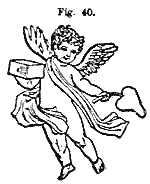
Therefore, the fruit of the Egyptian Persea was peculiarly sacred to him, from its resemblance to the "HUMAN HEART." Hence this infant divinity was frequently represented with a heart, or the heart-shaped fruit of the Persea, in one of his hands. The following extract, from John Bell's criticism on the antiques in the Picture Gallery of Florence, will show that the boyish divinity had been represented elsewhere also in ancient times in the same manner. Speaking of a statue of Cupid, he says it is "a fair, full, fleshy, round boy, in fine and sportive action, tossing back a heart." Thus the boy-god came to be regarded as the "god of the heart," in other words, as Cupid, or the god of love. To identify this infant divinity, with his father "the mighty hunter," he was equipped with "bow and arrows"; and in the hands of the poets, for the amusement of the profane vulgar, this sportive boy-god was celebrated as taking aim with his gold-tipped shafts at the hearts of mankind. His real character, however, as the above statement shows, and as we have seen reason already to conclude, was far higher and of a very different kind. He was the woman's seed. Venus and her son Cupid, then, were none other than the Madonna and the child. Looking at the subject in this light, the real force and meaning of the language will appear, which Virgil puts into the mouth of Venus, when addressing the youthful Cupid:--
"My son, my strength, whose
mighty power alone
Controls the thunderer on his awful throne,
To thee thy much afflicted mother flies,
And on thy succour and thy faith relies."
From what we have seen already as to the power and glory of the Goddess Mother being entirely built on the divine character attributed to her Son, the reader must see how exactly this is brought out, when the Son is called "THE STRENGTH" of his Mother. As the boy-god, whose symbol was the heart, was recognised as the god of childhood, this very satisfactorily accounts for one of the peculiar customs of the Romans. Kennett tells us, in his Antiquities, that the Roman youths, in their tender years, used to wear a golden ornament suspended from their necks, called bulla, which was hollow, and heart-shaped. Barker, in his work on Cilicia, while admitting that the Roman bulla was heart-shaped, further states, that "it was usual at the birth of a child to name it after some divine personage, who was supposed to receive it under his care"; but that the "name was not retained beyond infancy, when the bulla was given up." Who so likely to be the god under whose guardianship the Roman children were put, as the god under one or other of his many names whose express symbol they wore, and who, while he was recognised as the great and mighty war-god, who also exhibited himself in his favourite form as a little child?
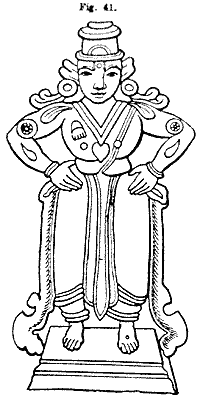
The veneration of the "sacred heart" seems also to have extended to India, for there Vishnu, the Mediatorial god, in one of his forms, with the mark of the wound in his foot, in consequence of which he died, and for which such lamentation is annually made, is represented as wearing a heart suspended on his breast. It is asked, How came it that the "Heart" became the recognised symbol of the Child of the great Mother? The answer is, "The Heart" in Chaldee is "BEL"; and as, at first, after the check given to idolatry, almost all the most important elements of the Chaldean system were introduced under a veil, so under that veil they continued to be shrouded from the gaze of the uninitiated, after the first reason--the reason of fear--had long ceased to operate. Now, the worship of the "Sacred Heart" was just, under a symbol, the worship of the "Sacred Bel," that mighty one of Babylon, who had died a martyr for idolatry; for Harpocrates, or Horus, the infant god, was regarded as Bel, born again. That this was in very deed the case, the following extract from Taylor, in one of his notes to his translation of the Orphic Hymns, will show. "While Bacchus," says he, was "beholding himself" with admiration "in a mirror, he was miserably torn to pieces by the Titans, who, not content with this cruelty, first boiled his members in water, and afterwards roasted them in the fire; but while they were tasting his flesh thus dressed, Jupiter, excited by the steam, and perceiving the cruelty of the deed, hurled his thunder at the Titans, but committed his members to Apollo, the brother of Bacchus, that they might be properly interred. And this being performed, Dionysius [i.e., Bacchus], (whose HEART, during his laceration, was snatched away by Minerva and preserved) by a new REGENERATION, again emerged, and he being restored to his pristine life and integrity, afterwards filled up the number of the gods." This surely shows, in a striking light, the peculiar sacredness of the heart of Bacchus; and that the regeneration of his heart has the very meaning I have attached to it--viz., the new birth or new incarnation of Nimrod or Bel. When Bel, however was born again as a child, he was, as we have seen, represented as an incarnation of the sun. Therefore, to indicate his connection with the fiery and burning sun, the "sacred heart" was frequently represented as a "heart of flame." So the "Sacred Heart" of Rome is actually worshipped as a flaming heart, as may be seen on the rosaries devoted to that worship. Of what use, then, is it to say that the "Sacred Heart" which Rome worships is called by the name of "Jesus," when not only is the devotion given to a material image borrowed from the worship of the Babylonian Antichrist, but when the attributes ascribed to that "Jesus" are not the attributes of the living and loving Saviour, but the genuine attributes of the ancient Moloch or Bel?