The Two Babylons
Chapter V
Rites and Ceremonies
Section
III
The Clothing and Crowning
of Images
In the Church of Rome, the clothing and crowning of images form no insignificant part of the ceremonial. The sacred images are not represented, like ordinary statues, with the garments formed of the same material as themselves, but they have garments put on them from time to time, like ordinary mortals of living flesh and blood. Great expense is often lavished on their drapery; and those who present to them splendid robes are believed thereby to gain their signal favour, and to lay up a large stock of merit for themselves. Thus, in September, 1852, we find the duke and Duchess of Montpensier celebrated in the Tablet, not only for their charity in "giving 3000 reals in alms to the poor," but especially, and above all, for their piety in "presenting the Virgin with a magnificent dress of tissue of gold, with white lace and a silver crown." Somewhat about the same time the piety of the dissolute Queen of Spain was testified by a similar benefaction, when she deposited at the feet of the Queen of Heaven the homage of the dress and jewels she wore on a previous occasion of solemn thanksgiving, as well as the dress in which she was attired when she was stabbed by the assassin Merino. "The mantle," says the Spanish journal Espana, "exhibited the marks of the wound, and its ermine lining was stained with the precious blood of Her Majesty. In the basket (that bore the dresses) were likewise the jewels which adorned Her Majesty's head and breast. Among them was a diamond stomacher, so exquisitely wrought, and so dazzling, that it appeared to be wrought of a single stone." This is all sufficiently childish, and presents human nature in a most humiliating aspect; but it is just copied from the old Pagan worship. The same clothing and adorning of the gods went on in Egypt, and there were sacred persons who alone could be permitted to interfere with so high a function. Thus, in the Rosetta Stone we find these sacred functionaries distinctly referred to: "The chief priests and prophets, and those who have access to the adytum to clothe the gods,...assembled in the temple at Memphis, established the following decree." The "clothing of the gods" occupied an equally important place in the sacred ceremonial of ancient Greece. Thus, we find Pausanias referring to a present made to Minerva: "In after times Laodice, the daughter of Agapenor, sent a veil to Tegea, to Minerva Alea." The epigram [inscription] on this offering indicates, at the same time, the origin of Laodice:--
"Laodice,
from Cyprus, the divine,
To her paternal wide-extended land,
This veil--an offering to Minerva--sent."
Thus, also, when Hecuba, the Trojan queen, in the instance already referred to, was directed to lead the penitential procession through the streets of Troy to Minverva's temple, she was commanded not to go empty-handed, but to carry along with her, as her most acceptable offering:--
"The
largest mantle your full wardrobes hold,
Most prized for art, and laboured o'er with gold."
The royal lady punctually obeyed:--
"The
Phrygian queen to her rich wardrobe went,
Where treasured odours breathed a costly scent;
There lay the vestures of no vulgar art;
Sidonian maids embroidered every part,
Whom from soft Sydon youthful Paris bore,
With Helen touching on the Tyrian shore.
Here, as the Queen revolved with careful eyes
The various textures and the various dyes,
She chose a veil that shone superior far,
And glowed refulgent as the morning star."
There is surely a wonderful resemblance here between the piety of the Queen of Troy and that of the Queen of Spain. Now, in ancient Paganism there was a mystery couched under the clothing of the gods. If gods and goddesses were so much pleased by being clothed, it was because there had once been a time in their history when they stood greatly in need of clothing. Yes, it can be distinctly established, as has been already hinted, that ultimately the great god and great goddess of Heathenism, while the facts of their own history were interwoven with their idolatrous system, were worshipped also as incarnations of our great progenitors, whose disastrous fall stripped them of their primeval glory, and made it needful that the hand Divine should cover their nakedness with clothing specially prepared for them. I cannot enter here into an elaborate proof of this point; but let the statement of Herodotus be pondered in regard to the annual ceremony, observed in Egypt, of slaying a ram, and clothing the FATHER OF THE GODS with its skin. Compare this statement with the Divine record in Genesis about the clothing of the "Father of Mankind" in a coat of sheepskin; and after all that we have seen of the deification of dead men, can there be a doubt what it was that was thus annually commemorated? Nimrod himself, when he was cut in pieces, was necessarily stripped. That exposure was identified with the nakedness of Noah, and ultimately with that of Adam. His sufferings were represented as voluntarily undergone for the good of mankind. His nakedness, therefore, and the nakedness of the "Father of the gods," of whom he was an incarnation, was held to be a voluntary humiliation too. When, therefore, his suffering was over, and his humiliation past, the clothing in which he was invested was regarded as a meritorious clothing, available not only for himself, but for all who were initiated in his mysteries. In the sacred rites of the Babylonian god, both the exposure and the clothing that were represented as having taken place, in his own history, were repeated on all his worshippers, in accordance with the statement of Firmicus, that the initiated underwent what their god had undergone. First, after being duly prepared by magic rites and ceremonies, they were ushered, in a state of absolute nudity, into the innermost recesses of the temple. This appears from the following statement of Proclus: "In the most holy of the mysteries, they say that the mystics at first meet with the many-shaped genera [i.e., with evil demons], which are hurled forth before the gods: but on entering the interior parts of the temple, unmoved and guarded by the mystic rites, they genuinely receive in their bosom divine illumination, and, DIVESTED OF THEIR GARMENTS, participate, as they would say, of a divine nature." When the initiated, thus "illuminated" and made partakers of a "divine nature," after being "divested of their garments," were clothed anew, the garments with which they were invested were looked upon as "sacred garments," and possessing distinguished virtues. "The coat of skin" with which the Father of mankind was divinely invested after he was made so painfully sensible of his nakedness, was, as all intelligent theologians admit, a typical emblem of the glorious righteousness of Christ--"the garment of salvation," which is "unto all and upon all them that believe." The garments put upon the initiated after their disrobing of their former clothes, were evidently intended as a counterfeit of the same. "The garments of those initiated in the Eleusinian Mysteries," says Potter, "were accounted sacred, and of no less efficacy to avert evils than charms and incantations. They were never cast off till completely worn out." And of course, if possible, in these "sacred garments" they were buried; for Herodotus, speaking of Egypt, whence these mysteries were derived, tells us that "religion" prescribed the garments of the dead. The efficacy of "sacred garments" as a means of salvation and delivering from evil in the unseen and eternal world, occupies a foremost place in many religions. Thus the Parsees, the fundamental elements of whose system came from the Chaldean Zoroaster, believe that "the sadra or sacred vest" tends essentially to "preserve the departed soul from the calamities accruing from Ahriman," or the Devil; and they represent those who neglect the use of this "sacred vest" as suffering in their souls, and "uttering the most dreadful and appalling cries," on account of the torments inflicted on them "by all kinds of reptiles and noxious animals, who assail them with their teeth and stings, and give them not a moment's respite." What could have ever led mankind to attribute such virtue to a "sacred vest"? If it be admitted that it is just a perversion of the "sacred garment" put on our first parents, all is clear. This, too, accounts for the superstitious feeling in the Papacy, otherwise so unaccountable, that led so many in the dark ages to fortify themselves against the fears of the judgment to come, by seeking to be buried in a monk's dress. "To be buried in a friar's cast-off habit, accompanied by letters enrolling the deceased in a monastic order, was accounted a sure deliverance from eternal condemnation! In 'Piers the Ploughman's Creed,' a friar is described as wheedling a poor man out of his money by assuring him that, if he will only contribute to his monastery,
'St.
Francis himself shall fold thee in his cope,
And present thee to the Trinity, and pray for thy sins.'"
In virtue of the same superstitious belief, King John of England was buried in a monk's cowl; and many a royal and noble personage besides, "before life and immortality" were anew "brought to light" at the Reformation, could think of no better way to cover their naked and polluted souls in prospect of death, than by wrapping themselves in the garment of some monk or friar as unholy as themselves. Now, all these refuges of lies, in Popery as well as Paganism, taken in connection with the clothing of the saints of the one system, and of the gods of the other, when traced to their source, show that since sin entered the world, man has ever felt the need of a better righteousness than his own to cover him, and that the time was when all the tribes of the earth knew that the only righteousness that could avail for such a purpose was "the righteousness of God," and that of "God manifest in the flesh."
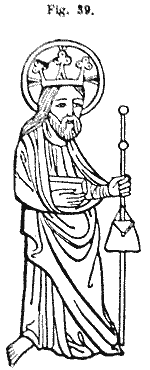
Intimately connected with the "clothing of the images of the saints" is also the "crowning" of them. For the last two centuries, in the Popish communion, the festivals for crowning the "sacred images" have been more and more celebrated. In Florence, a few years ago, the image of the Madonna with the child in her arms was "crowned" with unusual pomp and solemnity. Now, this too arose out of the facts commemorated in the history of Bacchus or Osiris. As Nimrod was the first king after the Flood, so Bacchus was celebrated as the first who wore a crown. *
* PLINY, Hist. Nat. Under the name of Saturn, also, the same thing was attributed to Nimrod.
When, however, he fell into the hands of his enemies, as he was stripped of all his glory and power, he was stripped also of his crown. The "Falling of the crown from the head of Osiris" was specially commemorated in Egypt. That crown at different times was represented in different ways, but in the most famous myth of Osiris it was represented as a "Melilot garland." Melilot is a species of trefoil; and trefoil in the Pagan system was one of the emblems of the Trinity. Among the Tractarians at this day, trefoil is used in the same symbolical sense as it has long been in the Papacy, from which Puseyism has borrowed it. Thus, in a blasphemous Popish representation of what is called God the Father (of the fourteenth century), we find him represented as wearing a crown with three points, each of which is surmounted with a leaf of white clover. But long before Tractarianism or Romanism was known, trefoil was a sacred symbol. The clover leaf was evidently a symbol of high import among the ancient Persians; for thus we find Herodotus referring to it, in describing the rites of the Persian Magi--"If any (Persian) intends to offer to a god, he leads the animal to a consecrated spot. Then, dividing the victim into parts, he boils the flesh, and lays it upon the most tender herbs, especially TREFOIL. This done, a magus--without a magus no sacrifice can be performed--sings a sacred hymn." In Greece, the clover, or trefoil, in some form or other, had also occupied an important place; for the rod of Mercury, the conductor of souls, to which such potency was ascribed, was called "Rabdos Tripetelos," or "the three-leaved rod." Among the British Druids the white clover leaf was held in high esteem as an emblem of their Triune God, and was borrowed from the same Babylonian source as the rest of their religion. The Melilot, or trefoil garland, then, with which the head of Osiris was bound, was the crown of the Trinity--the crown set on his head as the representative of the Eternal--"The crown of all the earth," in accordance with the voice divine at his birth, "The Lord of all the earth is born." Now, as that "Melilot garland," that crown of universal dominion, fell "from his head" before his death, so, when he rose to new life, the crown must be again set upon his head, and his universal dominion solemnly avouched. Hence, therefore, came the solemn crowning of the statues of the great god, and also the laying of the "chaplet" on his altar, as a trophy of his recovered "dominion." But if the great god was crowned, it was needful also that the great goddess should receive a similar honour. Therefore it was fabled that when Bacchus carried his wife Ariadne to heaven, in token of the high dignity bestowed upon her, he set a crown upon her head; and the remembrance of this crowning of the wife of the Babylonian god is perpetuated to this hour by the well-known figure in the sphere called Ariadnoea corona, or "Ariadne's crown." This is, beyond question, the real source of the Popish rite of crowning the image of the Virgin.
From the fact that the Melilot garland occupied so conspicuous a place in the myth of Osiris, and that the "chaplet" was laid on his altar, and his tomb was "crowned" with flowers, arose the custom, so prevalent in heathenism, of adorning the altars of the gods with "chaplets" of all sorts, and with a gay profusion of flowers. Side by side with this reason for decorating the altars with flowers, there was also another. When in
"That
fair field
Of Enna, Proserpine gathering flowers,
Herself, a fairer flower, by gloom Dis,
Was gathered;"
and all the flowers she had stored up in her lap were lost, the loss thereby sustained by the world not only drew forth her own tears, but was lamented in the Mysteries as a loss of no ordinary kind, a loss which not only stripped her of her own spiritual glory, but blasted the fertility and beauty of the earth itself. *
* OVID, Metamorphoses. Ovid speaks of the tears which Proserpine shed when, on her robe being torn from top to bottom, all the flowers which she had been gathering up in it fell to the ground, as showing only the simplicity of a girlish mind. But this is evidently only for the uninitiated. The lamentations of Ceres, which were intimately connected with the fall of these flowers, and the curse upon the ground that immediately followed, indicated something entirely different. But on that I cannot enter here.
That loss, however, the wife of Nimrod, under the name of Astarte, or Venus, was believed to have more than repaired. Therefore, while the sacred "chaplet" of the discrowned god was placed in triumph anew on his head and on his altars, the recovered flowers which Proserpine had lost were also laid on these altars along with it, in token of gratitude to that mother of grace and goodness, for the beauty and temporal blessings that the earth owed to her interposition and love. In Pagan Rome especially this was the case. The altars were profusely adorned with flowers. From that source directly the Papacy has borrowed the custom of adorning the altar with flowers; and from the Papacy, Puseyism, in Protestant England, is labouring to introduce the custom among ourselves. But, viewing it in connection with its source, surely men with the slightest spark of Christian feeling may well blush to think of such a thing. It is not only opposed to the genius of the Gospel dispensation, which requires that they who worship God, who is a Spirit, "worship Him in spirit and in truth"; but it is a direct symbolising with those who rejoiced in the re-establishment of Paganism in opposition to the worship of the one living and true God.