The Two Babylons
Chapter IV
Doctrine and Discipline
Section III
The Sacrifice of the Mass
If baptismal regeneration, the initiating ordinance of Rome, and justification by works, be both Chaldean, the principle embodied in the "unbloody sacrifice" of the mass is not less so. We have evidence that goes to show the Babylonian origin of the idea of that "unbloody sacrifice" very distinctly. From Tacitus we learn that no blood was allowed to be offered on the altars of Paphian Venus. Victims were used for the purposes of the Haruspex, that presages of the issues of events might be drawn from the inspection of the entrails of these victims; but the altars of the Paphian goddess were required to be kept pure from blood. Tacitus shows that the Haruspex of the temple of the Paphian Venus was brought from Cilicia, for his knowledge of her rites, that they might be duly performed according to the supposed will of the goddess, the Cilicians having peculiar knowledge of her rites. Now, Tarsus, the capital of Cilicia, was built by Sennacerib, the Assyrian king, in express imitation of Babylon. Its religion would naturally correspond; and when we find "unbloody sacrifice" in Cyprus, whose priest came from Cilicia, that, in the circumstances, is itself a strong presumption that the "unbloody sacrifice" came to it through Cilicia from Babylon. This presumption is greatly strengthened when we find from Herodotus that the peculiar and abominable institution of Babylon in prostituting virgins in honour of Mylitta, was observed also in Cyprus in honour of Venus. But the positive testimony of Pausanias brings this presumption to a certainty. "Near this," says that historian, speaking of the temple of Vulcan at Athens, "is the temple of Celestial Venus, who was first worshipped by the Assyrians, and after these by the Paphians in Cyprus, and the Phoenicians who inhabited the city of Ascalon in Palestine. But the Cythereans venerated this goddess in consequence of learning her sacred rites from the Phoenicians." The Assyrian Venus, then--that is, the great goddess of Babylon--and the Cyprian Venus were one and the same, and consequently the "bloodless" altars of the Paphian goddess show the character of the worship peculiar to the Babylonian goddess, from whom she was derived. In this respect the goddess-queen of Chaldea differed from her son, who was worshipped in her arms. He was, as we have seen, represented as delighting in blood. But she, as the mother of grace and mercy, as the celestial "Dove," as "the hope of the whole world," (BRYANT) was averse to blood, and was represented in a benign and gentle character. Accordingly, in Babylon she bore the name of Mylitta--that is, "The Mediatrix." *
* Mylitta is the same as Melitta, the feminine of Melitz, "a mediator," which in Chaldee becomes Melitt. Melitz is the word used in Job 33:23, 24: "If there be a messenger with him, an interpreter (Heb. Melitz, "a mediator"), one among a thousand, to show unto man his uprightness, then he is gracious unto him, and saith, Deliver him from going down to the pit; I have found a ransom."
Every one who reads the Bible, and sees how expressly it declares that, as there is only "one God," so there is only "one Mediator between God and man" (1 Tim 2:5), must marvel how it could ever have entered the mind of any one to bestow on Mary, as is done by the Church of Rome, the character of the "Mediatrix." But the character ascribed to the Babylonian goddess as Mylitta sufficiently accounts for this. In accordance with this character of Mediatrix, she was called Aphrodite--that is, "the wrath-subduer" *--who by her charms could soothe the breast of angry Jove, and soften the most rugged spirits of gods or mortal-men. In Athens she was called Amarusia (PAUSANIAS)--that is, "The Mother of gracious acceptance." **
* From Chaldee "aph," "wrath," and "radah," "to subdue"; "radite" is the feminine emphatic.
** From "Ama," "mother," and "Retza," "to accept graciously," which in the participle active is "Rutza." Pausanias expresses his perplexity as to the meaning of the name Amarusia as applied to Diana, saying, "Concerning which appellation I never could find any one able to give a satisfactory account." The sacred tongue plainly shows the meaning of it.
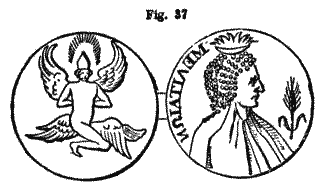
In Rome she was called "Bona Dea," "the good goddess," the mysteries of this goddess being celebrated by women with peculiar secrecy. In India the goddess Lakshmi, "the Mother of the Universe," the consort of Vishnu, is represented also as possessing the most gracious and genial disposition; and that disposition is indicated in the same way as in the case of the Babylonian goddess. "In the festivals of Lakshmi," says Coleman, "no sanguinary sacrifices are offered." In China, the great gods, on whom the final destinies of mankind depend, are held up to the popular mind as objects of dread; but the goddess Kuanyin, "the goddess of mercy," whom the Chinese of Canton recognise as bearing an analogy to the Virgin or Rome, is described as looking with an eye of compassion on the guilty, and interposing to save miserable souls even from torments to which in the world of spirits they have been doomed. Therefore she is regarded with peculiar favour by the Chinese. This character of the goddess-mother has evidently radiated in all directions from Chaldea. Now, thus we see how it comes that Rome represents Christ, the "Lamb of God," meek and lowly in heart, who never brake the bruised reed, nor quenched the smoking flax--who spake words of sweetest encouragement to every mourning penitent--who wept over Jerusalem--who prayed for His murderers--as a stern and inexorable judge, before whom the sinner "might grovel in the dust, and still never be sure that his prayers would be heard," while Mary is set off in the most winning and engaging light, as the hope of the guilty, as the grand refuge of sinners; how it is that the former is said to have "reserved justice and judgment to Himself," but to have committed the exercise of all mercy to His Mother! The most standard devotional works of Rome are pervaded by this very principle, exalting the compassion and gentleness of the mother at the expense of the loving character of the Son. Thus, St. Alphonsus Liguori tells his readers that the sinner that ventures to come directly to Christ may come with dread and apprehension of His wrath; but let him only employ the mediation of the Virgin with her Son, and she has only to "show" that Son "the breasts that gave him suck," (Catholic Layman, July, 1856) and His wrath will immediately be appeased. But where in the Word of God could such an idea have been found? Not surely in the answer of the Lord Jesus to the woman who exclaimed, "Blessed is the womb that bare thee, and the paps that thou hast sucked!" Jesus answered and said unto her, "Yea, rather, blessed are they that hear the Word of God and keep it" (Luke 11:27,28). There cannot be a doubt that this answer was given by the prescient Saviour, to check in the very bud every idea akin to that expressed by Liguori. Yet this idea, which is not to be found in Scripture, which the Scripture expressly repudiates, was widely diffused in the realms of Paganism. Thus we find an exactly parallel representation in the Hindoo mythology in regard to the god Siva and his wife Kali, when that god appeared as a little child. "Siva," says the Lainga Puran, "appeared as an infant in a cemetery, surrounded by ghosts, and on beholding him, Kali (his wife) took him up, and, caressing him, gave him her breast. He sucked the nectareous fluid; but becoming ANGRY, in order to divert and PACIFY him, Kali clasping him to her bosom, danced with her attendant goblins and demons amongst the dead, until he was pleased and delighted; while Vishnu, Brahma, Indra, and all the gods, bowing themselves, praised with laudatory strains the god of gods, Kal and Parvati." Kali, in India, is the goddess of destruction; but even into the myth that concerns this goddess of destruction, the power of the goddess mother, in appeasing an offended god, by means only suited to PACIFY a peevish child, has found an introduction. If the Hindoo story exhibits its "god of gods" in such a degrading light, how much more honouring is the Papal story to the Son of the Blessed, when it represents Him as needing to be pacified by His mother exposing to Him "the breasts that He has sucked." All this is done only to exalt the Mother, as more gracious and more compassionate than her glorious Son. Now, this was the very case in Babylon: and to this character of the goddess queen her favourite offerings exactly corresponded. Therefore, we find the women of Judah represented as simply "burning incense, pouring out drink-offerings, and offering cakes to the queen of heaven" (Jer 44:19). The cakes were "the unbloody sacrifice" she required. That "unbloody sacrifice" her votaries not only offered, but when admitted to the higher mysteries, they partook of, swearing anew fidelity to her. In the fourth century, when the queen of heaven, under the name of Mary, was beginning to be worshipped in the Christian Church, this "unbloody sacrifice" also was brought in. Epiphanius states that the practice of offering and eating it began among the women of Arabia; and at that time it was well known to have been adopted from the Pagans. The very shape of the unbloody sacrifice of Rome may indicate whence it came. It is a small thin, round wafer; and on its roundness the Church of Rome lays so much stress, to use the pithy language of John Knox in regard to the wafer-god, "If, in making the roundness the ring be broken, then must another of his fellow-cakes receive that honour to be made a god, and the crazed or cracked miserable cake, that once was in hope to be made a god, must be given to a baby to play withal." What could have induced the Papacy to insist so much on the "roundness" of its "unbloody sacrifice"? Clearly not any reference to the Divine institution of the Supper of our Lord; for in all the accounts that are given of it, no reference whatever is made to the form of the bread which our Lord took, when He blessed and break it, and gave it to His disciples, saying, "Take, eat; this is My body: this do in remembrance of Me." As little can it be taken from any regard to injunctions about the form of the Jewish Paschal bread; for no injunctions on that subject are given in the books of Moses. The importance, however, which Rome attaches to the roundness of the wafer, must have a reason; and that reason will be found, if we look at the altars of Egypt. "The thin, round cake," says Wilkinson, "occurs on all altars." Almost every jot or tittle in the Egyptian worship had a symbolical meaning. The round disk, so frequent in the sacred emblems of Egypt, symbolised the sun. Now, when Osiris, the sun-divinity, became incarnate, and was born, it was not merely that he should give his life as a sacrifice for men, but that he might also be the life and nourishment of the souls of men. It is universally admitted that Isis was the original of the Greek and Roman Ceres. But Ceres, be it observed, was worshipped not simply as the discoverer of corn; she was worshipped as "the MOTHER of Corn." The child she brought forth was He-Siri, "the Seed," or, as he was most frequently called in Assyria, "Bar," which signifies at once "the Son" and "the Corn." The uninitiated might reverence Ceres for the gift of material corn to nourish their bodies, but the initiated adored her for a higher gift--for food to nourish their souls--for giving them that bread of God that cometh down from heaven--for the life of the world, of which, "if a man eat, he shall never die." Does any one imagine that it is a mere New Testament doctrine, that Christ is the "bread of life"? There never was, there never could be, spiritual life in any soul, since the world began, at least since the expulsion from Eden, that was not nourished and supported by a continual feeding by faith on the Son of God, "in whom it hath pleased the Father that all fulness should dwell" (Col 1:19), "that out of His fulness we might receive, and grace for grace" (John 1:16). Paul tells us that the manna of which the Israelites ate in the wilderness was to them a type and lively symbol of "the bread of life"; (1 Cor 10:3), "They did all eat the same spiritual meat"--i.e., meat which was intended not only to support their natural lives, but to point them to Him who was the life of their souls. Now, Clement of Alexandria, to whom we are largely indebted for all the discoveries that, in modern times, have been made in Egypt, expressly assures us that, "in their hidden character, the enigmas of the Egyptians were VERY SIMILAR TO THOSE OF THE JEWS." That the initiated Pagans actually believed that the "Corn" which Ceres bestowed on the world was not the "Corn" of this earth, but the Divine "Son," through whom alone spiritual and eternal life could be enjoyed, we have clear and decisive proof. The Druids were devoted worshippers of Ceres, and as such they were celebrated in their mystic poems as "bearers of the ears of corn." Now, the following is the account which the Druids give of their great divinity, under the form of "Corn." That divinity was represented as having, in the first instance, incurred, for some reason or other, the displeasure of Ceres, and was fleeing in terror from her. In his terror, "he took the form of a bird, and mounted into the air. That element afforded him no refuge: for The Lady, in the form of a sparrow-hawk, was gaining upon him--she was just in the act of pouncing upon him. Shuddering with dread, he perceived a heap of clean wheat upon a floor, dropped into the midst of it, and assumed the form of a single grain. Ceridwen [i.e., the British Ceres] took the form of a black high-crested hen, descended into the wheat, scratched him out, distinguished, and swallowed him. And, as the history relates, she was pregnant of him nine months, and when delivered of him, she found him so lovely a babe, that she had not resolution to put him to death" ("Song of Taliesin," DAVIES'S British Druids). Here it is evident that the grain of corn, is expressly identified with "the lovely babe"; from which it is still further evident that Ceres, who, to the profane vulgar was known only as the Mother of "Bar," "the Corn," was known to the initiated as the Mother of "Bar," "the Son." And now, the reader will be prepared to understand the full significance of the representation in the Celestial sphere of "the Virgin with the ear of wheat in her hand." That ear of wheat in the Virgin's hand is just another symbol for the child in the arms of the Virgin Mother.
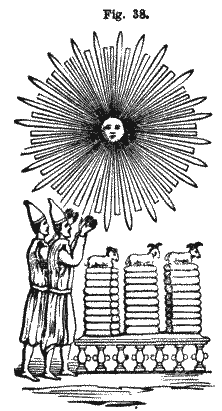
Now, this Son, who was symbolised as "Corn," was the SUN-divinity incarnate, according to the sacred oracle of the great goddess of Egypt: "No mortal hath lifted my veil. The fruit which I have brought forth is the SUN" (BUNSEN'S Egypt). What more natural then, if this incarnate divinity is symbolised as the "bread of God," than that he should be represented as a "round wafer," to identify him with the Sun? Is this a mere fancy? Let the reader peruse the following extract from Hurd, in which he describes the embellishments of the Romish altar, on which the sacrament or consecrated wafer is deposited, and then he will be able to judge: "A plate of silver, in the form of a SUN, is fixed opposite to the SACRAMENT on the altar; which, with the light of the tapers, makes a most brilliant appearance." What has that "brilliant" "Sun" to do there, on the altar, over against the "sacrament," or round wafer? In Egypt, the disk of the Sun was represented in the temples, and the sovereign and his wife and children were represented as adoring it. Near the small town of Babin, in Upper Egypt, there still exists in a grotto, a representation of a sacrifice to the sun, where two priests are seen worshipping the sun's image. In the great temple of Babylon, the golden image of the Sun was exhibited for the worship of the Babylonians. In the temple of Cuzco, in Peru, the disk of the sun was fixed up in flaming gold upon the wall, that all who entered might bow down before it. The Paeonians of Thrace were sun-worshippers; and in their worship they adored an image of the sun in the form of a disk at the top of a long pole. In the worship of Baal, as practised by the idolatrous Israelites in the days of their apostacy, the worship of the sun's image was equally observed; and it is striking to find that the image of the sun, which apostate Israel worshipped, was erected above the altar. When the good king Josiah set about the work of reformation, we read that his servants in carrying out the work, proceeded thus (2 Chron 34:4): "And they brake down the altars of Baalim in his presence, and the images (margin, SUN-IMAGES) that were on high above them, he cut down." Benjamin of Tudela, the great Jewish traveller, gives a striking account of sun-worship even in comparatively modern times, as subsisting among the Cushites of the East, from which we find that the image of the sun was, even in his day, worshipped on the altar. "There is a temple," says he, "of the posterity of Chus, addicted to the contemplation of the stars. They worship the sun as a god, and the whole country, for half-a-mile round their town, is filled with great altars dedicated to him. By the dawn of morn they get up and run out of town, to wait the rising sun, to whom, on every altar, there is a consecrated image, not in the likeness of a man, but of the solar orb, framed by magic art. These orbs, as soon as the sun rises, take fire, and resound with a great noise, while everybody there, men and women, hold censers in their hands, and all burn incense to the sun." From all this, it is manifest that the image of the sun above, or on the altar, was one of the recognised symbols of those who worshipped Baal or the sun. And here, in a so-called Christian Church, a brilliant plate of silver, "in the form of a SUN," is so placed on the altar, that every one who adores at that altar must bow down in lowly reverence before that image of the "Sun." Whence, I ask, could that have come, but from the ancient sun-worship, or the worship of Baal? And when the wafer is so placed that the silver "SUN" is fronting the "round" wafer, whose "roundness" is so important an element in the Romish Mystery, what can be the meaning of it, but just to show to those who have eyes to see, that the "Wafer" itself is only another symbol of Baal, or the Sun. If the sun-divinity was worshipped in Egypt as "the Seed," or in Babylon as the "Corn," precisely so is the wafer adored in Rome. "Bread-corn of the elect, have mercy upon us," is one of the appointed prayers of the Roman Litany, addressed to the wafer, in the celebration of the mass. And one at least of the imperative requirements as to the way in which that wafer is to be partaken of, is the very same as was enforced in the old worship of the Babylonian divinity. Those who partake of it are required to partake absolutely fasting. This is very stringently laid down. Bishop Hay, laying down the law on the subject, says that it is indispensable, "that we be fasting from midnight, so as to have taken nothing into our stomach from twelve o'clock at night before we receive, neither food, nor drink, nor medicine." Considering that our Lord Jesus Christ instituted the Holy Communion immediately after His disciples had partaken of the paschal feast, such a strict requirement of fasting might seem very unaccountable. But look at this provision in regard to the "unbloody sacrifice" of the mass in the light of the Eleusinian Mysteries, and it is accounted for at once; for there the first question put to those who sought initiation was, "Are you fasting?" (POTTER, Eleusiania) and unless that question was answered in the affirmative, no initiation could take place. There is no question that fasting is in certain circumstances a Christian duty; but while neither the letter nor the spirit of the Divine institution requires any such stringent regulation as the above, the regulations in regard to the Babylonian Mysteries make it evident whence this requirement has really come.
Although the god whom Isis or Ceres brought forth, and who was offered to her under the symbol of the wafer or thin round cake, as "the bread of life," was in reality the fierce, scorching Sun, or terrible Moloch, yet in that offering all his terror was veiled, and everything repulsive was cast into the shade. In the appointed symbol he is offered up to the benignant Mother, who tempers judgment with mercy, and to whom all spiritual blessings are ultimately referred; and blessed by that mother, he is given back to be feasted upon, as the staff of life, as the nourishment of her worshippers' souls. Thus the Mother was held up as the favourite divinity. And thus, also, and for an entirely similar reason, does the Madonna of Rome entirely eclipse her son as the "Mother of grace and mercy."
In regard to the Pagan character of the "unbloody sacrifice" of the mass, we have seen not little already. But there is something yet to be considered, in which the working of the mystery of iniquity will still further appear. There are letters on the wafer that are worth reading. These letters are I. H. S. What mean these mystical letters? To a Christian these letters are represented as signifying, "Iesus Hominum Salvator," "Jesus the Saviour of men." But let a Roman worshipper of Isis (for in the age of the emperors there were innumerable worshippers of Isis in Rome) cast his eyes upon them, and how will he read them? He will read them, of course, according to his own well known system of idolatry: "Isis, Horus, Seb," that is, "The Mother, the Child, and the Father of the gods,"--in other words, "The Egyptian Trinity." Can the reader imagine that this double sense is accidental? Surely not. The very same spirit that converted the festival of the Pagan Oannes into the feast of the Christian Joannes, retaining at the same time all its ancient Paganism, has skilfully planned the initials I. H. S. to pay the semblance of a tribute to Christianity, while Paganism in reality has all the substance of the homage bestowed upon it.
When the women of Arabia began to adopt this wafer and offer the "unbloody sacrifice," all genuine Christians saw at once the real character of their sacrifice. They were treated as heretics, and branded with the name of Collyridians, from the Greek name for the cake which they employed. But Rome saw that the heresy might be turned to account; and therefore, though condemned by the sound portion of the Church, the practice of offering and eating this "unbloody sacrifice" was patronised by the Papacy; and now, throughout the whole bounds of the Romish communion, it has superseded the simple but most precious sacrament of the Supper instituted by our Lord Himself.
Intimately connected with the sacrifice of the mass is the subject of transubstantiation; but the consideration of it will come more conveniently at a subsequent stage of this inquiry.